



What's Happening?
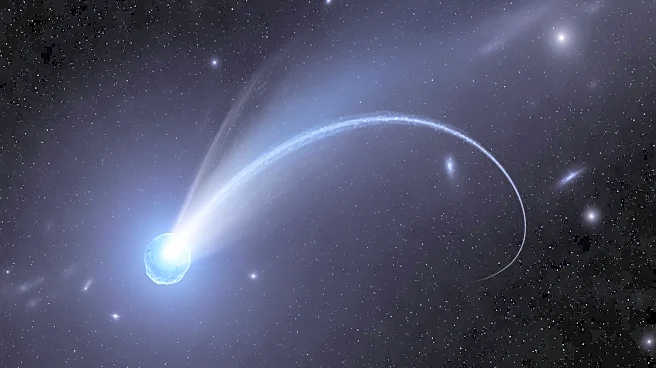
NASA is closely observing the interstellar comet 3I/ATLAS as it makes its closest approach to Earth on December 19, 2025. This comet is the third known object from outside our solar system to be discovered within it. Despite its proximity, the comet poses
no threat to Earth, remaining about 170 million miles away. Skywatchers can potentially view the comet with a telescope of at least 30 centimeters in aperture. Additionally, the Geminid Meteor Shower is set to peak on December 13 and 14, offering a display of bright and colorful meteors. A conjunction between the Moon and Jupiter will also occur on December 7, providing another celestial event for observers.
Why It's Important?
The observation of comet 3I/ATLAS provides a unique opportunity for scientists to study an interstellar object, offering insights into the composition and behavior of celestial bodies from beyond our solar system. The Geminid Meteor Shower and the conjunction of the Moon and Jupiter are significant for both amateur and professional astronomers, as they offer opportunities for public engagement and education in astronomy. These events highlight the ongoing efforts of NASA and other space agencies to explore and understand our universe, fostering interest and investment in space science.
What's Next?
As comet 3I/ATLAS continues its journey through our solar system, NASA will keep monitoring it using various spacecraft and telescopes. The data collected will contribute to our understanding of interstellar objects. The upcoming celestial events, such as the Geminid Meteor Shower and the Moon-Jupiter conjunction, will likely attract skywatchers and astronomers, prompting local observatories to host viewing events. These events may also inspire educational programs and public outreach initiatives to increase awareness and interest in space exploration.