










What's Happening?
Coral reefs, vital underwater ecosystems supporting approximately 25% of all marine species, are facing severe threats primarily from coral bleaching. This phenomenon occurs when elevated sea surface temperatures, exceeding local summer maximums by 1-2°C
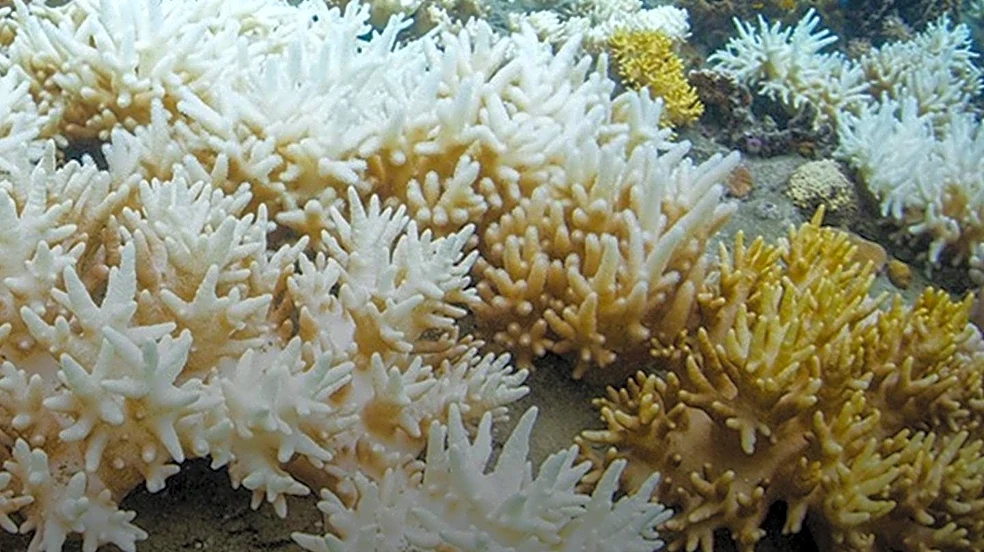
for several weeks, cause corals to expel their symbiotic algae. This expulsion reveals the corals' white calcium carbonate skeletons, leaving them energetically compromised with reduced growth, reproduction, and disease resistance. While not immediately fatal, persistent stress leads to widespread coral mortality. The 1997-1998 El Niño event marked the first documented global mass bleaching, impacting reefs in 60 countries and causing an estimated 16% loss of the world's coral reefs. Subsequent global events in 2010 and 2014-2017 were even more widespread and damaging. Beyond thermal stress, other triggers include high solar irradiance, sub-aerial exposure during extreme low tides, salinity anomalies, sedimentation, and pollutants like oxybenzone.
Why It's Important?
The degradation of coral reefs has profound ecological and socioeconomic consequences. Ecologically, severe bleaching leads to coral mortality, erosion of the reef framework, and shifts towards macroalgal dominance, fundamentally altering ecosystem structure and function. This results in declines in fish diversity as their habitats collapse, with studies documenting 50-90% reductions in reef fish biomass on severely bleached reefs. Socioeconomically, coral reefs provide ecosystem services valued at $9.9 trillion annually, including coastal protection by dissipating 97% of wave energy, food security for approximately 500 million people, and tourism revenue exceeding $36 billion globally. For instance, Australia's Great Barrier Reef alone contributes AUD 6.4 billion annually to the economy and supports 64,000 jobs. The loss of these reefs would devastate coastal communities, economies reliant on tourism and fisheries, and exacerbate food insecurity in many regions.
What's Next?
Recovery from coral bleaching is possible if thermal stress subsides and corals regain their symbionts, a process that can take months to years. However, repeated bleaching events at intervals shorter than recovery times (typically 10-15 years for fast-growing species, decades for slow-growing massive corals) lead to irreversible degradation. Conservation efforts are now focusing on marine protected areas (MPAs), assisted evolution techniques like coral gardening and larval propagation, and urgent climate action. The IPCC Sixth Assessment Report projects that at 1.5°C warming, 70-90% of coral reefs will be lost, and at 2°C, over 99% face severe degradation. Achieving the Paris Agreement's 1.5°C target is considered a survival threshold for these ecosystems, requiring global greenhouse gas emissions to peak before 2025 and decline 43% by 2030. Concurrently, reducing local stressors such as overfishing, destructive fishing, coastal pollution, and sedimentation is crucial to enhance reef resilience and provide critical recovery time.
Beyond the Headlines
The ongoing coral bleaching crisis highlights the intricate link between global climate change and local environmental health. The decline of coral reefs represents not just an ecological disaster but also a significant ethical and cultural loss, as these vibrant ecosystems hold deep cultural significance for many indigenous communities and are a source of inspiration and wonder globally. The challenge of preserving coral reefs also underscores the need for international cooperation and the implementation of comprehensive, multi-faceted strategies that combine global emissions reductions with local conservation efforts. The long-term shifts triggered by this development could include widespread biodiversity loss, altered ocean chemistry, and significant economic disruption, particularly in developing nations heavily reliant on reef ecosystems. The situation also raises questions about the effectiveness of current international environmental policies and the urgency required to address climate change on a global scale.