






What's Happening?
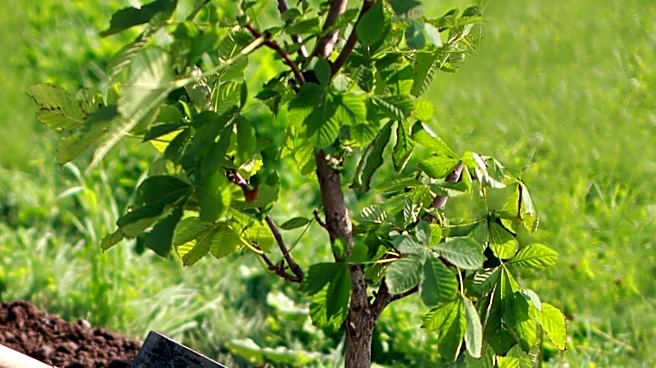
A climate watchdog has issued a warning that Ireland is set to 'grossly fail' in achieving its annual target of planting 22 million trees, which translates to 8,000 hectares. A climate action plan established by the government in 2019 aimed for an 18%
increase in forest cover by mid-century. However, the government missed its 2025 target by a substantial 68%, planting only 2,527 hectares, or approximately 6.9 million trees. The situation has worsened, with only 1,573 hectares planted in 2024, following 1,652 hectares in 2023 and 2,273 hectares in 2022. As of June this year, only 777 hectares (about 2.1 million trees) have been planted, a significant decrease compared to 1,513 hectares (about 4.2 million trees) by the same time last year. The Climate Change Advisory Council's latest annual review indicates that the commitment to 18% tree cover is becoming 'increasingly unrealistic' and highlights the forestry sector as a 'particular concern'. The council also noted that the agricultural sector failed to meet its 10% emissions reduction target last year and is unlikely to meet its 2030 targets without a 'stronger push'.
Why It's Important?
The failure to meet these ambitious tree-planting targets has significant implications for Ireland's environmental commitments and broader climate change mitigation efforts. Forestation is a critical component of carbon sequestration, and falling short on these goals means a reduced capacity to absorb atmospheric carbon dioxide, directly impacting the country's ability to combat climate change. This shortfall also jeopardizes Ireland's adherence to both EU and national environmental targets, potentially weakening its contribution to international agreements like the Paris Agreement. Furthermore, the report highlights concerns about the decline in domestic horticultural producers, which increases Ireland's vulnerability to external shocks in its food supply and distribution. This not only poses a risk to food security but also represents a missed opportunity to reduce the carbon footprint associated with food imports. The agricultural sector's struggle to meet emissions reduction targets further compounds the environmental challenge, indicating a systemic issue in integrating sustainable practices across key economic sectors. The council's observations about the impacts of extreme weather events on agriculture, such as prolonged winter rainfall and summer heat stress, underscore the urgent need for robust climate adaptation strategies to protect crop yields, fodder reserves, and animal welfare.
What's Next?
The Climate Change Advisory Council has recommended that the next Forestry Programme, scheduled for 2028, must address the challenge of achieving 18% national forest cover by 2040 with a renewed sense of urgency. This suggests a need for a comprehensive re-evaluation of current strategies and the implementation of more effective measures to incentivize and facilitate tree planting. The council's criticism of the existing Forestry Programme, despite increased funding, indicates that economic incentives alone are insufficient. Future programs will likely need to tackle non-economic barriers, such as administrative burdens and the perceived irreversibility of planting decisions for farmers. Addressing farmers' concerns that prime agricultural land should be used for food production will also be crucial. The fact that many landowners are engaging with the application process but not proceeding with planting suggests a disconnect between policy and practical implementation that needs to be resolved. Additionally, there will be increased pressure on the agricultural sector to implement a 'stronger push' to meet its 2030 emissions reduction targets. This could involve new policies, technological advancements, or changes in farming practices to reduce environmental impact. The ongoing monitoring by the climate watchdog will continue to highlight these deficiencies, potentially leading to further policy adjustments and increased scrutiny from both national and international bodies.
Beyond the Headlines
The challenges faced by Ireland in meeting its tree-planting and emissions reduction targets reveal deeper systemic issues beyond mere policy implementation. The council's findings point to a significant behavioral and cultural resistance among landowners and farmers, who prioritize food production on prime agricultural land over afforestation, despite financial incentives. This highlights a fundamental tension between agricultural productivity and environmental conservation, a dilemma common in many nations. The 'replanting obligation' and administrative burdens associated with forestry schemes also underscore the need for policies that are not only well-intentioned but also practical and user-friendly for those on the ground. The decline in domestic horticultural production and the resulting increased vulnerability to external shocks expose a broader issue of national resilience and self-sufficiency in food supply, which has significant implications for economic stability and national security. This situation also brings to light the ethical considerations of land use and the long-term environmental stewardship required to mitigate climate change. The ongoing struggle to meet these targets could trigger a re-evaluation of Ireland's overall climate strategy, potentially leading to more integrated approaches that balance economic needs with ecological imperatives, and a greater emphasis on community engagement and education to foster a shared sense of responsibility for environmental goals.