




What's Happening?
Rear Admiral Chris Cavanaugh, Commander, Submarine Forces, U.S. Pacific Fleet (COMSUBPAC), has issued a warning regarding the rapid expansion of Chinese and Russian submarine fleets. Speaking at the Navy Submarine League’s 2026 Annual Symposium, Rear Admiral Cavanaugh highlighted
that the growth in adversary SSGNs and SSBNs has significant implications for the U.S. Navy's ability to maintain domain awareness with its current force structure. He identified the People’s Liberation Army Navy (PLAN) as the top threat in the Indo-Pacific, noting the rapid rate at which China is commissioning new submarines, including 8 Type 093B (Shang III) Nuclear Fast Attack Submarines in under four years. U.S. assessments suggest China can sustain this production rate for at least a decade, potentially adding 20-40 Shang III or improved SSNs. Rear Admiral Cavanaugh also noted qualitative improvements in Chinese submarines, such as advanced quieting techniques, Vertical Launch Cell banks, and significant propulsion changes. Russia's continued investment in its strategic deterrent, particularly newer Project 955 Borei-class SSBNs and Yasen-class SSGNs, also poses a potent threat, especially when combined with the Chinese fleet. North Korea's advancements in submarine technology, though still under U.S. Navy assessment, contribute to an increasingly dense undersea threat environment.
Why It's Important?
The rapid expansion and qualitative improvements in Chinese and Russian submarine fleets directly challenge U.S. undersea dominance and strategic stability. For the U.S. Navy, this means a heightened need for advanced surveillance, detection, and counter-submarine capabilities to maintain domain awareness and protect its interests and allies. The increased number of adversary submarines, particularly those with enhanced stealth and strike capabilities, could complicate U.S. naval operations and potentially shift the balance of power in critical maritime regions like the Indo-Pacific. The development of advanced Chinese submarines with features like pump-jet propulsion and Vertical Launch Cells signifies a closing technological gap, requiring the U.S. to accelerate its own modernization efforts. Furthermore, Russia's investment in quiet, missile-carrying submarines like the Yasen-class poses a direct threat to U.S. coastal security. This evolving threat landscape necessitates continuous investment in U.S. submarine production, technology, and personnel to ensure the nation's strategic deterrence and defense capabilities remain superior.
What's Next?
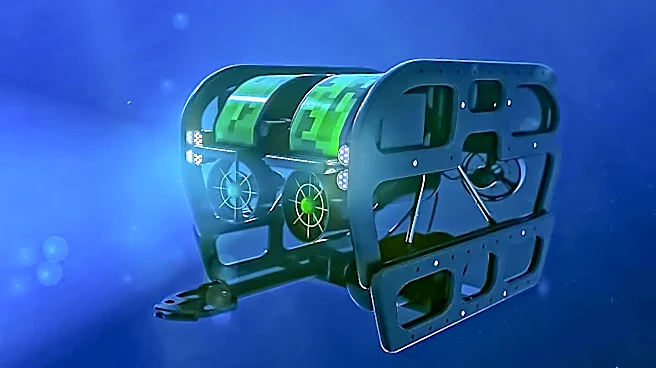
In response to these growing threats, the U.S. Navy will likely continue to prioritize the modernization and expansion of its own submarine fleet, including accelerating the production of Virginia-class and Columbia-class submarines. Increased investment in undersea surveillance technologies, anti-submarine warfare capabilities, and intelligence gathering will be critical. The U.S. will also likely strengthen its alliances, such as the AUKUS partnership, to enhance collective security and interoperability in the Indo-Pacific. This includes supporting allies like Australia in developing their own nuclear-powered submarine capabilities. Furthermore, there will be a continued focus on monitoring and analyzing the advancements of adversary navies, particularly China's ongoing research into oceanographic mapping and Unmanned Underwater Vehicles (UUVs), which contribute to a holistic approach to undersea warfare. The U.S. Navy will need to adapt its doctrine and training to operate effectively in an increasingly complex and contested undersea environment.
Beyond the Headlines
The warnings from Rear Admiral Cavanaugh highlight a broader geopolitical competition unfolding beneath the ocean's surface, often out of public view. This 'silent war' involves not only the development of advanced submarines but also sophisticated intelligence gathering, oceanographic research, and the deployment of unmanned systems. The qualitative improvements in Chinese submarines, such as the Shang III class, suggest a strategic shift from quantity to quality, indicating China's ambition to become a peer competitor in undersea warfare. The combined threat from China and Russia, along with emerging capabilities from North Korea, creates a multi-faceted challenge that demands a comprehensive and adaptive U.S. response. This competition extends beyond military hardware to include human capital, industrial capacity, and technological innovation. The long-term implications could include a re-evaluation of international maritime laws, increased naval presence in strategic choke points, and a greater emphasis on undersea deterrence as a cornerstone of national security.