






What's Happening?
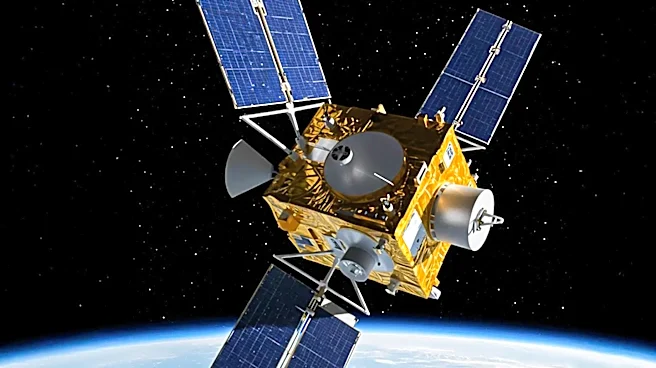
Thales Alenia Space, a joint venture between Thales and Leonardo, has signed a contract with OHB Italia to develop the PRISMA Second Generation Earth observation satellite for the Italian Space Agency (ASI). Scheduled for launch in 2031, this satellite will
feature a hyperspectral instrument built by Leonardo, offering enhanced functional and resolution capabilities compared to its predecessor. The PRISMA Second Generation satellite aims to improve spatial resolution to at least 10 meters, a significant enhancement from the current 30 meters. This development is part of a broader effort to advance Earth observation technologies, providing better image quality of Earth's surface, vegetation, inland waters, and coastal areas. The industrial consortium led by OHB Italia will oversee the mission and system activities, while Thales Alenia Space will develop the satellite and deliver the PRIMA-S platform, which can accommodate both radar and optical payloads.
Why It's Important?
The development of the PRISMA Second Generation satellite is crucial for advancing Earth observation capabilities, which are vital for environmental monitoring and resource management. Enhanced spatial resolution and new functional capabilities will allow for more precise data collection, benefiting scientific research and operational applications. This project underscores the strategic importance of international collaborations in space technology, as it involves key players like Thales Alenia Space, OHB Italia, and the Italian Space Agency. The satellite's improved capabilities will support a wide range of applications, from environmental resource management to understanding global phenomena, thereby contributing to more informed decision-making processes in various sectors.
What's Next?
The PRISMA Second Generation satellite is set for launch in 2031, and its development will involve continued collaboration between Thales Alenia Space, OHB Italia, and the Italian Space Agency. As the project progresses, stakeholders will focus on integrating the hyperspectral instrument and ensuring the satellite meets the diverse requirements of scientific and operational users. The successful deployment of this satellite could lead to further advancements in Earth observation technologies and potentially inspire similar international collaborations in the future.
Beyond the Headlines
The PRISMA Second Generation satellite represents a significant step forward in hyperspectral technology, which is essential for capturing high-quality images with frequent revisit times and a high signal-to-noise ratio. This advancement could lead to new insights into environmental changes and resource management, offering long-term benefits for both scientific communities and policymakers. Additionally, the project highlights the growing importance of space technology in addressing global challenges, such as climate change and sustainable development.