




What's Happening?
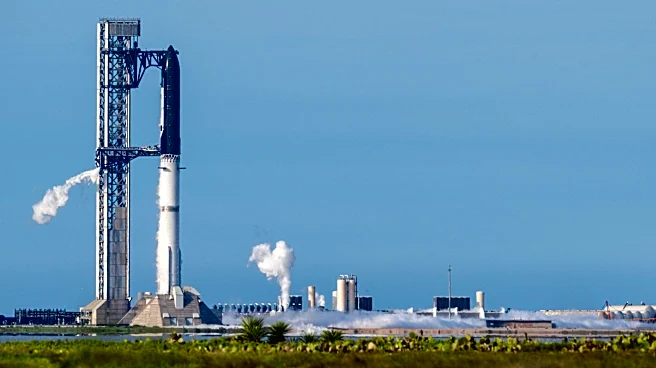
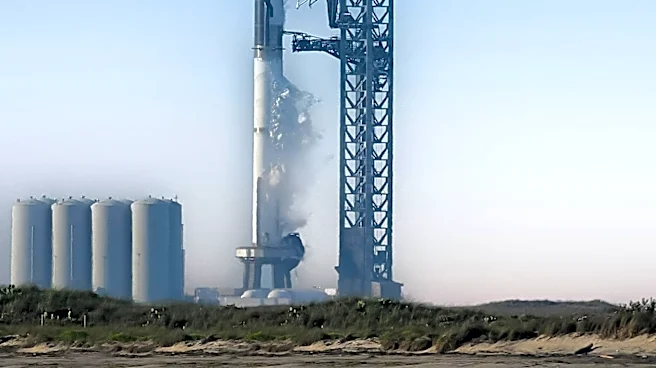
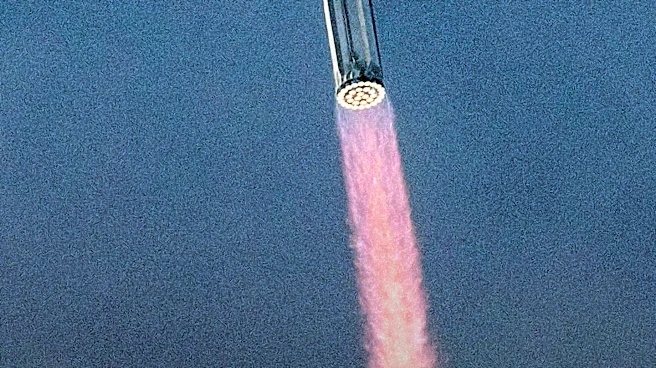
SpaceX successfully completed its 15th Starship test flight from Starbase, Texas, which included the first recovery of an orbital Starship spacecraft. The Starship completed 14 orbits over approximately 22.5 hours before its engines slowed its descent,
allowing Mechazilla's mechanical arms, dubbed 'chopsticks,' to capture it. This milestone follows previous attempts, including an unsuccessful recovery of the Super Heavy booster. ARK Invest CEO Cathie Wood lauded the achievement, suggesting it will inspire young people and marks a 'mind-blowing beginning' for space exploration. SpaceX CEO Elon Musk also engaged in a public discussion, challenging critics who attribute the company's success solely to capital and engineering, by contrasting SpaceX's launch reliability with competitors like Blue Origin, Boeing Co., and Lockheed Martin Corp.
Why It's Important?
This successful recovery of an orbital Starship spacecraft represents a significant advancement in reusable rocket technology, a core tenet of SpaceX's strategy to reduce the cost of space travel. The ability to recover and reuse the orbital stage of Starship could dramatically lower the expenses associated with launching payloads and humans into space, potentially accelerating the development of space-based industries and exploration. For the U.S. space sector, this achievement reinforces SpaceX's leadership and could spur further innovation among competitors. Economically, the reduced costs of space access could open new markets for satellite deployment, space tourism, and resource utilization, benefiting various U.S. industries. Furthermore, the public discourse initiated by Elon Musk highlights the competitive landscape within the aerospace industry and the impact of private innovation versus government-backed programs.
What's Next?
The successful 'chopsticks' catch of the Starship upper stage is expected to pave the way for more frequent and ambitious Starship missions. This recovery method is crucial for the full reusability of the Starship system, which is central to SpaceX's long-term goals, including lunar and Martian missions. Future tests will likely focus on refining the recovery process for both the Starship and its Super Heavy booster. The continued development of Starship is also critical for NASA's Artemis program, as Starship is designated as the Human Landing System for the first crewed Moon landing, targeted for early 2028. The progress of Starship could influence the timelines and feasibility of these major U.S. space initiatives, potentially accelerating human presence beyond Earth orbit.
Beyond the Headlines
The successful recovery of Starship carries profound implications beyond immediate technical achievements. It symbolizes a shift in the paradigm of space exploration, moving from expendable rockets to fully reusable systems, which could democratize access to space. This development could foster a new era of space-based economic activity, including manufacturing, energy generation, and scientific research, potentially creating new industries and job markets in the U.S. The inspiration cited by Cathie Wood underscores the cultural impact of such feats, potentially encouraging more young people to pursue STEM fields. Ethically, the increased accessibility to space raises questions about orbital debris, space traffic management, and the long-term sustainability of space operations, which will require international cooperation and regulatory frameworks.