
What's Happening?
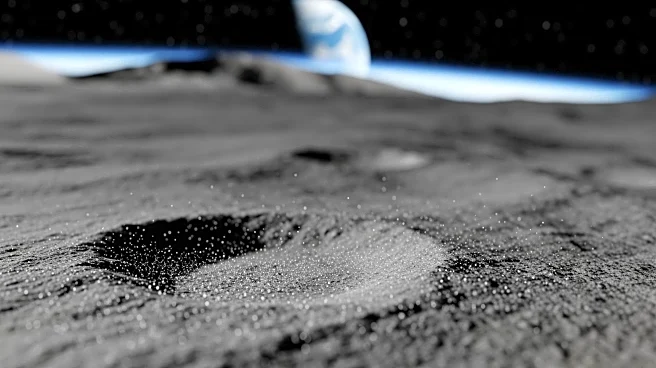
Recent research suggests that particles from Earth's atmosphere have been transported to the Moon via the solar wind, embedding themselves in the lunar soil. This discovery challenges previous assumptions
about the role of Earth's magnetic field, which was thought to prevent atmospheric particles from escaping into space. The study, conducted by the University of Rochester, indicates that the magnetic field may actually guide these particles toward the Moon. This finding helps explain the presence of certain volatile elements in lunar samples that cannot be accounted for by the solar wind alone. The research provides a new perspective on the interaction between Earth's atmosphere and the Moon, suggesting that the lunar surface may serve as a long-term archive of Earth's atmospheric history.
Why It's Important?
The implications of this research are significant for understanding both Earth's atmospheric history and the potential for lunar resource utilization. By analyzing the particles embedded in the lunar soil, scientists can gain insights into the historical composition of Earth's atmosphere, including changes due to natural events and human activity. This could enhance our understanding of Earth's climate history and atmospheric evolution. Additionally, the presence of Earth-derived volatiles on the Moon could support future lunar exploration and habitation efforts. If these resources can be efficiently extracted, they could provide essential materials for sustaining human presence on the Moon, reducing the need for resupply missions from Earth.
Beyond the Headlines
The study also offers broader implications for planetary science, particularly in understanding atmospheric escape mechanisms on other planets. For instance, Mars once had a global magnetic field and a thicker atmosphere, similar to early Earth. By studying the interactions between magnetic fields, solar wind, and atmospheric particles, scientists can better understand the conditions that allow planets to retain or lose their atmospheres. This knowledge is crucial for assessing planetary habitability and the potential for life on other worlds. The research underscores the Moon's value as both a scientific resource and a potential stepping stone for deeper space exploration.