





What's Happening?
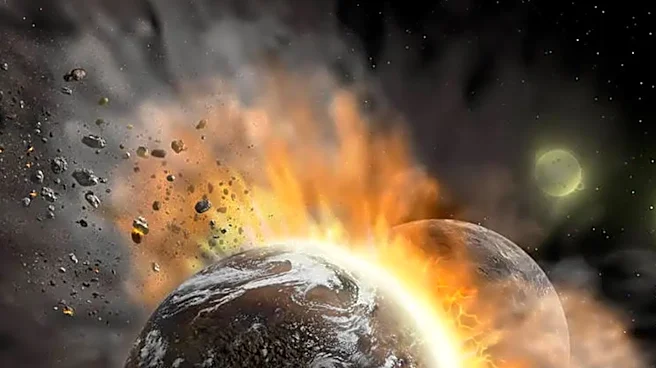
A recent analysis by New York University geologist Michael Rampino suggests that Earth's major geological events, such as mass extinctions and volcanic eruptions, may follow a hidden periodic cycle of approximately 27.5 million years. This study revisits
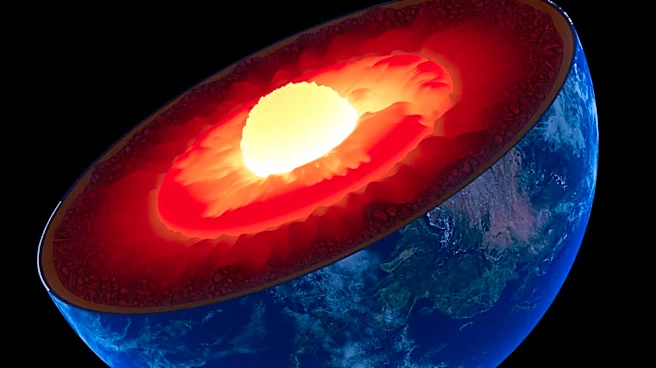
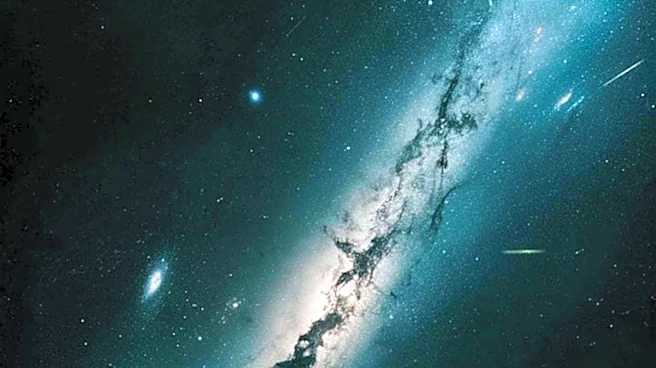
earlier hypotheses from the 1980s, using updated geological timescales and statistical methods to examine 89 significant geological events over the past 260 million years. The findings indicate a dominant periodicity, suggesting that these events might be interconnected through long-term processes rather than being isolated incidents. The study explores potential drivers of this cycle, including deep Earth processes like mantle convection and external influences such as the Solar System's oscillation through the Milky Way's mid-plane.
Why It's Important?
The implications of this study are significant for understanding Earth's geological history and future. If confirmed, the periodicity could reshape current geological theories, suggesting that Earth's largest upheavals are not random but part of a recurring cycle. This could influence how scientists predict and prepare for future geological events, potentially impacting public policy and disaster preparedness strategies. The study also opens new avenues for research into the underlying processes driving these cycles, which could include both terrestrial and extraterrestrial factors. Understanding these patterns could provide insights into the long-term stability and changes in Earth's environment, affecting everything from biodiversity to climate change.
What's Next?
Further research is needed to confirm the proposed 27.5-million-year cycle and to identify the specific processes driving it. This could involve more detailed geological studies and the development of new models to simulate Earth's long-term geological behavior. The scientific community may also explore the potential role of extraterrestrial influences, such as gravitational interactions with the Milky Way, in shaping Earth's geological history. As the debate continues, these findings could lead to a paradigm shift in Earth sciences, prompting a reevaluation of how geological events are understood and predicted.
Beyond the Headlines
The study's suggestion of a periodic geological cycle challenges long-held views in Earth sciences, potentially leading to a conceptual breakthrough. It raises questions about the interconnectedness of Earth's systems and the influence of cosmic factors on geological processes. The idea that Earth's history is shaped by recurring cycles rather than isolated events could have profound implications for understanding the planet's past and future. This perspective may also influence how humanity perceives its place in the universe, highlighting the complex interplay between Earth and its cosmic environment.