





What's Happening?
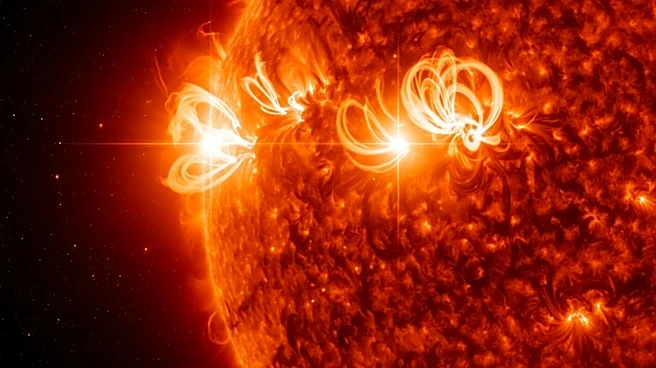
NASA has reported that two intense solar flares erupted from the sun within a span of seven hours, causing significant radio signal disruptions on Earth. These solar flares, classified as X-class, are among the most powerful types of solar flares. The first
flare peaked on April 23 at 9:07 p.m. ET, followed by a second flare at 4:13 a.m. ET on April 24. The flares were captured by NASA's Solar Dynamics Observatory, which monitors solar activity. The flares caused radio blackouts across the Pacific Ocean, Australia, and East Asia. These solar events were accompanied by coronal mass ejections (CMEs), which are large expulsions of plasma and magnetic fields from the sun. Although CMEs can be destructive, they are not expected to directly impact Earth due to the sunspot's position on the sun's western edge.
Why It's Important?
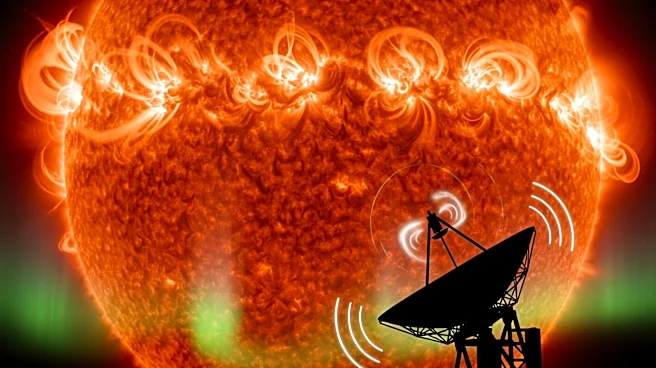
The occurrence of these solar flares highlights the potential vulnerabilities of Earth's technological infrastructure to solar activity. Solar flares can disrupt radio communications, electric power grids, and navigation systems, posing risks to both terrestrial and space-based operations. The recent flares, being the strongest in months, underscore the need for continuous monitoring and preparedness to mitigate the impacts of such solar events. The potential for geomagnetic storms and aurora displays, should the CMEs affect Earth, also emphasizes the interconnectedness of solar activity and terrestrial phenomena. Understanding and predicting solar flares are crucial for safeguarding communication networks and ensuring the safety of astronauts and spacecraft.
What's Next?
Forecasters are closely monitoring the paths of the coronal mass ejections to determine any potential impacts on Earth. While a direct hit is unlikely, a glancing blow could still trigger geomagnetic storm conditions. This would result in vivid aurora displays and could further affect communication systems. Continued observation and research into solar activity are essential for improving predictive models and developing strategies to protect critical infrastructure from solar-induced disruptions.