







What's Happening?
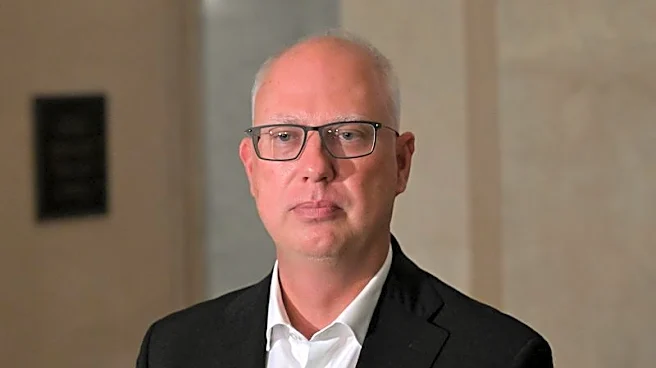
Professor Ulf Leonhardt, a physicist at the Weizmann Institute of Science, is conducting groundbreaking research into manipulating light to achieve invisibility and to better understand dark energy, one of the universe's greatest mysteries. Leonhardt's
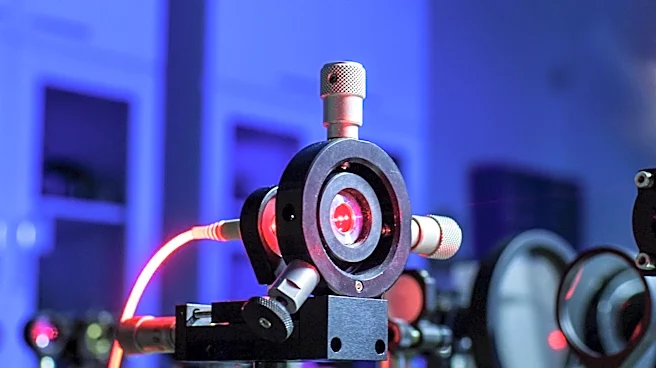
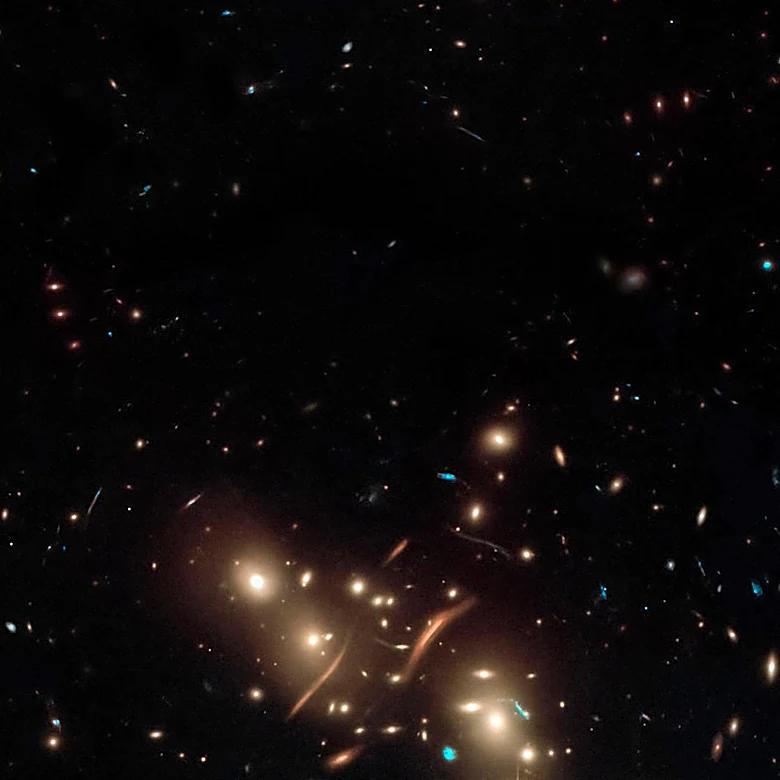
work builds on the theoretical concept of using metamaterials to bend light rays around an object, making it appear invisible. While full-scale invisibility cloaks for humans remain science fiction due to technological and cost limitations, experimental demonstrations have successfully concealed tiny objects and even events in time. Leonhardt is also applying insights from material physics to spacetime to address cosmological tensions, such as the 'Hubble tension' and the 'S8 tension,' and to explain how quantum vacuum fluctuations might produce dark energy.
Why It's Important?
Professor Leonhardt's research holds profound implications for both fundamental physics and potential technological advancements. His work on invisibility, while currently limited to small scales, could pave the way for future applications in areas like stealth technology, advanced optics, and even civil engineering, such as diverting seismic waves to protect structures. More significantly, his efforts to connect material physics with the mysteries of dark energy and cosmological tensions could revolutionize our understanding of the universe. Resolving these tensions could lead to a new standard model of cosmology, impacting how scientists perceive the fundamental forces and composition of the cosmos. This research pushes the boundaries of theoretical physics, potentially leading to discoveries that reshape scientific paradigms and open new avenues for exploration.
What's Next?
Professor Leonhardt and his team will continue to refine their theoretical models and conduct experiments to further explore the manipulation of light and its implications for cosmology. Future research will likely focus on developing more flexible and effective metamaterials for invisibility applications, even if limited to microscopic scales. In the realm of cosmology, the next steps involve rigorous testing of his model against more observational data and seeking validation from the broader scientific community. The ongoing work aims to provide a more comprehensive explanation for dark energy and resolve existing cosmological tensions. Collaborations with other research groups, particularly those in China, are expected to advance the practical applications of invisibility concepts.
Beyond the Headlines
Professor Leonhardt's journey from East Germany, where he felt 'something was wrong with the world,' to his current pioneering research, offers a compelling narrative about the human quest for understanding. His work on invisibility and dark energy transcends mere scientific inquiry; it delves into philosophical questions about perception, reality, and the unknown. The ethical considerations he raises regarding the potential misuse of invisibility technology, such as by military forces, highlight the responsibility that comes with scientific advancement. Furthermore, his unconventional approach to tackling cosmological problems, drawing analogies between material physics and spacetime, challenges established scientific norms and underscores the importance of interdisciplinary thinking. His story is a testament to the power of curiosity and perseverance in pushing the boundaries of human knowledge, even when facing skepticism from the scientific community.