



What's Happening?
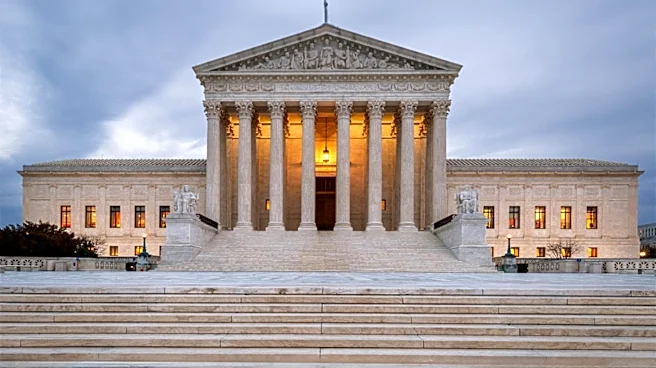
Republican Study Committee Member Nick Langworthy (NY-23) has publicly criticized efforts by Democrats to expand the number of justices on the Supreme Court, arguing that such actions politicize the judiciary and threaten its independence. In an op-ed,
Langworthy stated that these efforts, which he attributes to the 'radical Left,' aim to pack the Court with 'activist liberal judges' to achieve desired outcomes when decisions do not align with their political agenda. He highlights that Republicans are countering these moves with H.J. Res. 1, a proposed constitutional amendment that would explicitly mandate the Supreme Court to consist of nine justices. Langworthy notes that a significant majority of House Democrats voted against this resolution. He further connects this opposition to the rise of the Democratic Socialists of America (DSA), suggesting that their advocacy for a judiciary subordinate to Congress indicates a broader socialist agenda. Langworthy emphasizes that the Founding Fathers intended for an independent judiciary, as enshrined in Article III of the Constitution, to ensure equal justice under law, free from the political whims of Congress or the White House.
Why It's Important?
The debate over the size and composition of the Supreme Court carries significant implications for the U.S. political system and the balance of power. An independent judiciary is a cornerstone of American democracy, designed to interpret laws and the Constitution without succumbing to political pressure. Efforts to expand the Court, often termed 'court packing,' are viewed by critics like Rep. Langworthy as a direct assault on this independence, potentially transforming the Court into a partisan tool rather than an impartial arbiter. If successful, such a move could undermine public trust in the judiciary, leading to perceptions that legal decisions are driven by political ideology rather than legal principles. This could have far-reaching consequences for the stability and legitimacy of the American legal system, affecting everything from civil rights to economic regulations, as future rulings might be seen as products of political maneuvering rather than objective legal interpretation. The proposed H.J. Res. 1 aims to safeguard the current nine-justice structure, reflecting a deep concern among some lawmakers about preserving the Court's traditional role and preventing its weaponization for political ends.
What's Next?
The legislative battle over the Supreme Court's structure is expected to continue, with H.J. Res. 1 serving as a key Republican initiative to enshrine the nine-justice limit in the Constitution. The resolution's future will depend on its ability to garner bipartisan support, which appears challenging given the current political climate and the strong opposition from most House Democrats. The ongoing public discourse surrounding judicial independence and the role of the Supreme Court in American society will likely intensify, especially as major cases come before the Court and as the next election cycle approaches. Political leaders, advocacy groups, and the media will continue to debate the merits and dangers of court expansion, influencing public opinion and potentially shaping future legislative efforts. The outcome of this debate could determine the long-term integrity and perceived impartiality of the U.S. judicial system, with implications for how constitutional law is interpreted and applied for generations.
Beyond the Headlines
Beyond the immediate political skirmishes, the debate over Supreme Court expansion touches upon fundamental questions about the nature of American democracy and the separation of powers. The concept of an independent judiciary, free from political interference, is a delicate balance that has evolved over centuries. Any significant alteration to the Court's structure could set a precedent, potentially leading to future attempts by whichever party holds power to reshape the judiciary to its advantage. This could erode the checks and balances designed to prevent any single branch of government from becoming too powerful. Furthermore, the discussion highlights a growing ideological divide within American politics, where even foundational institutions like the Supreme Court become battlegrounds for partisan control. The long-term implications could include a judiciary whose legitimacy is constantly questioned, leading to decreased public confidence in the rule of law and potentially exacerbating societal polarization. The integrity of the Constitution and the stability of democratic governance are at stake in this ongoing struggle.