
What's Happening?
A recent report by the United Nations University's Institute for Water, Environment and Health (UNU-INWEH) has highlighted a looming global crisis termed 'water bankruptcy.' This condition arises when
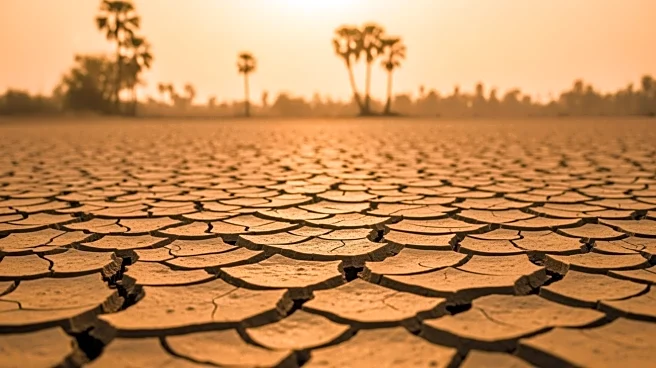
the Earth's water resources, such as rivers, lakes, and aquifers, are being depleted faster than they can be replenished. The report indicates that human water use has exceeded renewable sources, potentially reaching a point of no return. The situation is particularly dire in regions like the Middle East, North Africa, South Asia, and the American Southwest, where water systems are already failing. The report notes that about 75% of the global population lives in water-insecure countries, with billions facing severe water scarcities, lack of sanitation, and declining water storage. The depletion of natural wetlands, which serve as 'shock absorbers' for the water cycle, further exacerbates the crisis.
Why It's Important?
The implications of 'water bankruptcy' are profound, affecting food security, employment, migration, and geopolitical stability. As water resources dwindle, millions of farmers struggle to produce food, leading to potential increases in food prices and economic instability. The report warns that without a shift towards water-smart agriculture, the crisis will worsen. Additionally, the depletion of water resources can lead to social unrest and conflict, as communities compete for limited supplies. The U.N. emphasizes the need for equitable management of water resources to maintain peace and social cohesion. This crisis underscores the urgent need for global cooperation and innovative solutions to manage water resources sustainably.
What's Next?
The report calls for a combination of strategies to address the crisis, including restoring lost water resources, preventing further depletion, and adapting to current water availability. It highlights the importance of transitioning to water-smart agricultural practices to mitigate the impact on food production. The U.N. stresses the need for fair management of water resources to protect vulnerable communities and ensure equitable distribution of unavoidable losses. As the crisis unfolds, international collaboration and policy changes will be crucial in addressing the challenges posed by water scarcity.
Beyond the Headlines
The concept of 'water bankruptcy' introduces a new dimension to global environmental challenges, emphasizing the interconnectedness of water resources with economic and social stability. The report suggests that managing water resources fairly is central to maintaining peace and stability, highlighting the ethical responsibility of nations to protect vulnerable populations. The long-term implications of this crisis could reshape global priorities, driving innovation in water management and conservation. As the world grapples with this challenge, it may also prompt a reevaluation of consumption patterns and a shift towards more sustainable practices.