What's Happening?
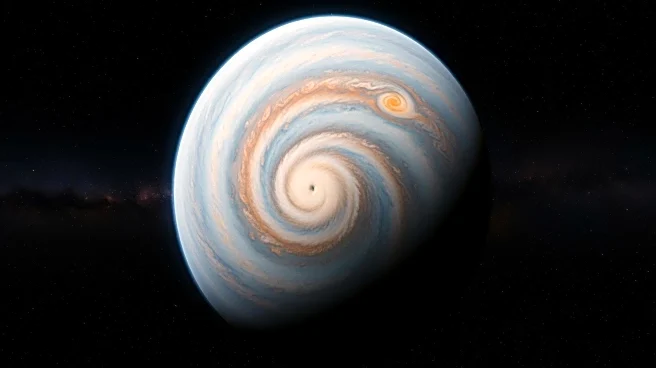
Astronomers have identified a rare cosmic object, a starless cloud known as Cloud-9, located approximately 14 million light-years from Earth near the spiral galaxy Messier 94 (M94). This discovery was
made using the Hubble Space Telescope and confirmed by the Green Bank Telescope in West Virginia. Cloud-9 is classified as a Reionization-Limited HI Cloud (RELHIC), a type of 'failed galaxy' that consists of a compact cloud of hydrogen gas without any stars. The cloud's existence supports the Lambda Cold Dark Matter (CDM) model, which predicts that some dark matter halos capture gas but do not form stars due to thermal equilibrium. Cloud-9's dark matter halo is estimated to have a mass of about 100 million solar masses, placing it at the threshold where galaxy formation becomes inefficient.
Why It's Important?
The discovery of Cloud-9 is significant as it provides empirical evidence for a key prediction of the Lambda CDM cosmological model, which is foundational to our understanding of the universe's structure. This model suggests that not all dark matter halos will form galaxies, and Cloud-9 exemplifies this by being a starless entity. The finding helps astronomers understand the conditions under which galaxies fail to form, offering insights into the processes that govern galaxy formation and evolution. It also highlights the role of dark matter in shaping the universe, as Cloud-9's existence suggests that dark matter can influence the formation of cosmic structures even when stars are absent.
What's Next?
Future research will likely focus on identifying more RELHICs to better understand the conditions that lead to their formation. Astronomers may use advanced telescopes to search for similar starless clouds and study their properties in detail. Additionally, simulations and observational campaigns could be conducted to explore the interactions between dark matter halos and hydrogen gas, further elucidating the processes that prevent star formation. This research could refine cosmological models and improve predictions about the distribution and behavior of dark matter in the universe.
Beyond the Headlines
The discovery of Cloud-9 opens up new avenues for exploring the dark universe, particularly the role of dark matter in cosmic evolution. It challenges astronomers to rethink the criteria for galaxy formation and the factors that can inhibit it. The study of RELHICs like Cloud-9 could also have implications for understanding the early universe, as these objects may represent relics from a time when galaxies were first forming. This could lead to a deeper understanding of the universe's history and the forces that have shaped its current structure.