


What's Happening?
Trinidad and Tobago and the European Union conducted a Partnership Dialogue on November 6, 2026, under the Samoa Agreement. The high-level meeting, held in a hybrid format, focused on political and economic developments in a changing geopolitical landscape.
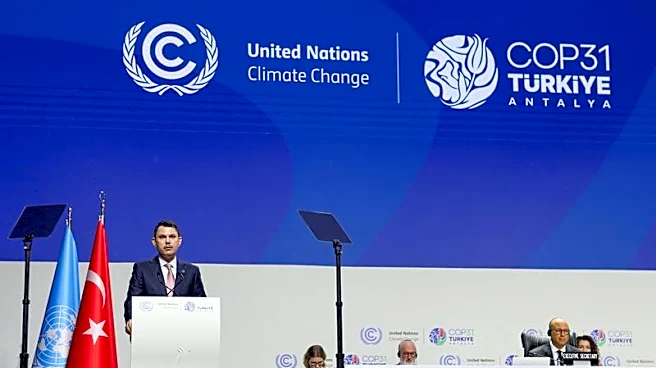
Discussions included bilateral political partnership, cooperation in multilateral forums, investment opportunities, human rights and governance, environmental cooperation, and peace and security. The Trinidad and Tobago delegation was led by the Honourable Sean Sobers, M.P., Minister of Foreign and CARICOM Affairs, while the EU delegation was headed by Mr. Pelayo Castro, Director for the Americas at the European External Action Service. Both parties reaffirmed their commitment to the principles of the UN Charter, including sovereignty and territorial integrity, and discussed Russia’s war of aggression against Ukraine. They also underscored their commitment to climate action, biodiversity conservation, and energy transition in anticipation of COP31. The CARIFORUM-EU Economic Partnership Agreement (EPA) was a key topic, with both sides emphasizing its ratification and full implementation to boost trade and investment. The EU presented its Global Gateway Investment Agenda, and Trinidad and Tobago expressed interest in aligning these initiatives with its national development priorities. Shared security concerns, including transnational organized crime and cyber threats, were also addressed.
Why It's Important?
This dialogue is important as it highlights ongoing efforts in multilateral cooperation between the European Union and Caribbean nations, particularly Trinidad and Tobago. The discussions on economic development, investment opportunities, and the implementation of the CARIFORUM-EU Economic Partnership Agreement (EPA) could significantly impact trade relations and economic growth for both regions. For the U.S., strong economic partnerships in the Caribbean can contribute to regional stability and reduce potential vulnerabilities. The focus on human rights, governance, and peace and security aligns with broader international efforts to promote democratic values and stability, which are often areas of U.S. foreign policy interest. Furthermore, the commitment to climate action and energy transition reflects a global trend towards sustainable development, which has implications for international climate agreements and potential U.S. involvement in related initiatives. The collaboration on addressing transnational organized crime and cyber threats is also crucial for regional security, an area where the U.S. often partners with international allies to combat shared challenges.
What's Next?
Trinidad and Tobago and the EU have agreed to maintain regular political dialogue on issues of mutual interest, indicating continued engagement and potential for further collaboration. The upcoming COP31 will be a critical juncture for both parties to demonstrate their commitment to climate action, biodiversity conservation, and energy transition, potentially leading to new initiatives or strengthened partnerships in these areas. The full implementation of the CARIFORUM-EU Economic Partnership Agreement (EPA) will be a key focus, with efforts to ratify and enact tariff liberalization obligations expected to continue. This could lead to increased trade and investment flows between the EU and CARIFORUM states. The EU's Global Gateway Investment Agenda, and Trinidad and Tobago's interest in aligning with it, suggests future collaborations in infrastructure, renewable energy, digital transformation, and pharmaceuticals. Continued cooperation on shared security concerns, such as transnational organized crime and cyber threats, is also anticipated, potentially involving joint efforts and information sharing.
Beyond the Headlines
The dialogue between Trinidad and Tobago and the EU underscores a broader trend of strengthening multilateralism and regional partnerships in response to complex global challenges. The emphasis on the Samoa Agreement highlights the evolving framework for cooperation between the EU and African, Caribbean, and Pacific states, moving beyond traditional aid relationships towards more equitable partnerships. The discussions on Russia's war of aggression against Ukraine, even in a Caribbean context, illustrate the interconnectedness of global security issues and the widespread commitment to international law and sovereignty. The focus on a 'Just Transition' in climate action, as mentioned in the context of COP31, reflects a growing recognition of the social and economic dimensions of environmental policies, aiming to ensure that climate initiatives do not disproportionately burden vulnerable communities. This holistic approach to international relations, integrating economic, environmental, and security concerns, signals a shift towards more comprehensive and interconnected foreign policy strategies among nations.