




What's Happening?
Power has been largely restored to Michigan State University's (MSU) East Lansing campus following a widespread outage that occurred on Saturday. Despite the restoration of electricity, hot water remains unavailable in most campus buildings. As a result,
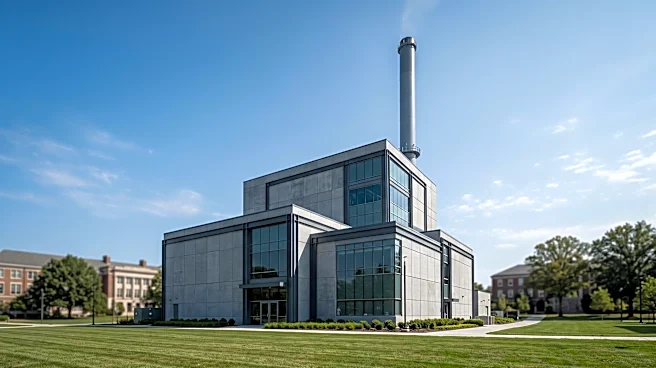
MSU has mandated that all East Lansing classes will be conducted online, and most employees are directed to work remotely until 11 p.m. on Monday. The university identified the cause of the outage as a power bus failure at the T.B. Simon Power Plant on Saturday. This failure disrupted the incoming electricity supply necessary for the plant's operation, consequently preventing it from generating both electricity and steam. The outage, which began around 4:15 p.m. on Saturday, left a significant portion of the campus without power for several hours. This led to the closure of dining halls, the cancellation of Saturday night's performance of 'Beetlejuice' at the Wharton Center, and the rescheduling of MSU's volleyball match against Wright State at the Breslin Center. Crews have been working in conjunction with Consumers Energy to restore the incoming power, and the T.B. Simon Power Plant is now partially operational. The university noted that condensation built up in the campus steam lines while the plant was down, and these lines serve over 100 buildings, with approximately 80% of the campus floor space relying on steam for hot water, including residence halls and dining facilities. Dining locations, however, remain open on Sunday. MSU President Kevin Guskiewicz confirmed that crews are continuing to address issues at the power plant. The directive for remote work and online classes applies exclusively to the East Lansing campus, and event cancellations or postponements are being handled on a case-by-case basis.
Why It's Important?
The power outage at Michigan State University highlights the critical infrastructure dependencies of large institutions and the cascading effects that a single point of failure can have on daily operations. The T.B. Simon Power Plant's malfunction not only cut off electricity but also disrupted steam generation, impacting essential services like hot water for a significant portion of the campus, including residence halls. This incident underscores the vulnerability of campus infrastructure to technical failures and the importance of robust contingency plans. The university's swift decision to move classes online and implement remote work for employees demonstrates an adaptive response to maintain academic continuity and ensure safety, reflecting lessons learned from previous disruptions, such as the pandemic. The cancellation of events like the 'Beetlejuice' performance and the volleyball match also illustrates the broader economic and social impact of such outages, affecting revenue, entertainment, and community engagement. Furthermore, the collaboration with Consumers Energy for power restoration emphasizes the interconnectedness of campus utilities with regional energy grids and the necessity of external partnerships in crisis management. The ongoing efforts to restore hot water services point to the complex nature of utility systems and the challenges in fully normalizing operations even after primary power is back online.
What's Next?
Michigan State University will continue its efforts to fully restore hot water services across the East Lansing campus, which remains a significant challenge due to condensation in the steam lines affecting a large number of buildings. The university will likely conduct a thorough investigation into the power bus failure at the T.B. Simon Power Plant to prevent future occurrences and assess the resilience of its energy infrastructure. This may lead to investments in upgrades or alternative power sources to enhance reliability. For students and faculty, the immediate next step involves adhering to the online class schedule and remote work directives through Monday, with further updates expected regarding the return to normal operations. The university will also need to address the financial implications of canceled events and potential reimbursements. In the longer term, this incident could prompt a review of MSU's emergency preparedness protocols, communication strategies during crises, and the overall robustness of its utility systems. Other large institutions and universities might also take note of this event as a case study for evaluating their own infrastructure vulnerabilities and emergency response plans, particularly concerning integrated power and steam generation systems.
Beyond the Headlines
The Michigan State University power outage, while seemingly a localized infrastructure failure, touches upon broader societal implications regarding energy resilience and the increasing reliance on complex, interconnected utility systems. The disruption of both electricity and steam services highlights how modern institutions are deeply dependent on a continuous flow of multiple forms of energy, and how a single point of failure can cascade into widespread inconvenience and operational halts. This incident serves as a microcosm of the challenges faced by urban centers and large organizations in maintaining critical infrastructure against both unforeseen technical failures and potential external threats. The university's response, particularly the rapid shift to online learning and remote work, also underscores the evolving nature of education and labor in the digital age, where physical presence is not always a prerequisite for continuity. This adaptability, while beneficial, also raises questions about digital equity and access for all students and employees during such disruptions. Furthermore, the incident could spark a broader conversation about sustainable energy solutions and decentralized power grids for large campuses, aiming to reduce reliance on single, vulnerable points of failure and enhance overall energy security in an era of increasing climate volatility and infrastructure aging.