






What's Happening?
The federal government has allocated $12 million to Tybee Island, Georgia, to advance its beach nourishment project, bringing the total funding for the $20 million initiative to completion. This funding, provided through the U.S. Army Corps of Engineers,
will enable the placement of approximately 1.3 million cubic yards of sand along Tybee’s shoreline to combat erosion. The announcement follows months of advocacy and collaboration involving the City of Tybee Island, Chatham County, the State of Georgia, U.S. Rep. Buddy Carter, U.S. Sen. Jon Ossoff, U.S. Sen. Raphael Warnock, and U.S. Rep. Mike Collins. Tybee Island is responsible for $8 million of the project cost, which was raised through city tax revenue and contributions from Chatham County and the State of Georgia. Construction and sand placement are anticipated to commence in December 2026.
Why It's Important?
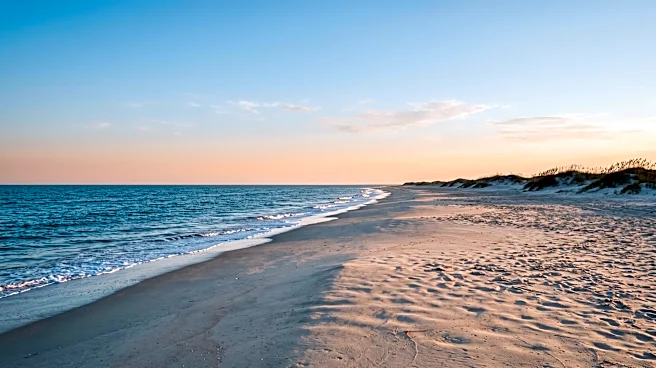
This federal funding is crucial for Tybee Island, as its beach is a vital natural asset, a significant contributor to its $200 million visitor economy, and a primary defense against ocean storms. The project addresses severe shoreline erosion, which has resulted in a 60 percent reduction in sand volume since 2020. Without this funding, the nourishment project would have been delayed until at least winter 2027-28, exacerbating the erosion problem and potentially impacting the local economy and coastal protection. The collaborative effort among federal, state, and local entities highlights the importance of intergovernmental partnerships in addressing critical environmental and economic challenges faced by coastal communities. The successful securing of funds ensures the preservation of Tybee's beach, which also serves as critical nesting grounds for sea turtles and supports nearly 1,200 jobs.
What's Next?
With the federal funding now secured, the City of Tybee Island will proceed with the U.S. Army Corps of Engineers on the next steps for construction and sand placement. The project is expected to begin in December 2026. This will involve detailed planning and logistical coordination to ensure the efficient and effective placement of 1.3 million cubic yards of sand. The successful completion of this project will restore the beach to a condition that supports both the local ecosystem and the tourism industry. Local officials will continue to monitor the progress of the project and engage with stakeholders to ensure its timely and successful execution, aiming to mitigate further erosion and protect the island's natural and economic resources.
Beyond the Headlines
The Tybee Island beach nourishment project exemplifies the broader national challenge of coastal erosion and the increasing need for federal and local investment in shoreline protection. Beyond its immediate economic and environmental benefits, this project underscores the long-term implications of climate change and rising sea levels on coastal communities. The persistent advocacy by Tybee Island officials and their federal and state partners highlights the political and logistical complexities involved in securing funding for such large-scale environmental initiatives. This project also serves as a model for other coastal areas facing similar threats, demonstrating how a concerted, multi-level governmental effort can lead to successful outcomes. The preservation of Tybee's beach not only protects property and livelihoods but also maintains the ecological balance of critical habitats, such as sea turtle nesting grounds, contributing to broader conservation efforts.