


What's Happening?
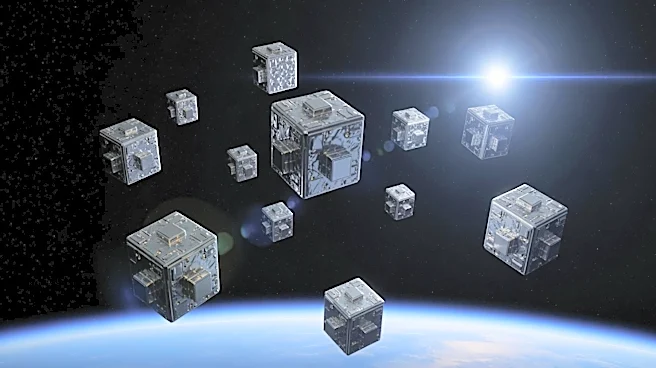
NASA has successfully launched several science and technology payloads aboard a SpaceX Falcon 9 rocket from Vandenberg Space Force Base in California. This launch, part of SpaceX's Transporter-16 commercial rideshare mission, included CubeSats designed
to test new thermal protection methods, improve in-space communications, and study Earth's atmosphere. Among these, the AEPEX CubeSat is focused on understanding how energetic particles transfer energy from radiation belts into the upper atmosphere, which is crucial for improving space weather predictions. Additionally, three satellites aim to enhance the World Magnetic Model, vital for national security and aviation. The mission also includes testing new technologies like a radiation sensor and an exo-brake device for rapid deorbiting, which could significantly advance satellite communications and space weather monitoring.
Why It's Important?
This mission represents a significant step in advancing space technology and research, particularly in understanding space weather, which can impact satellite operations and communications on Earth. By utilizing cost-effective rideshare opportunities, NASA accelerates technology development and innovation, strengthening the orbital economy. The advancements in thermal protection and in-space communications could lead to more efficient and safer space missions. Moreover, the improvements in the World Magnetic Model are crucial for navigation systems used in various sectors, including national security and aviation, highlighting the mission's broad impact on both scientific research and practical applications.
What's Next?
In the coming weeks, further tests will be conducted, including Varda Space's W6 capsule collecting heat and pressure data during reentry. This will test NASA-made instrumented heat shield tiles, which are expected to improve future mission safety and efficiency. The continued collaboration between NASA and commercial partners like SpaceX is likely to lead to more innovative and cost-effective solutions for space exploration challenges.