


What's Happening?
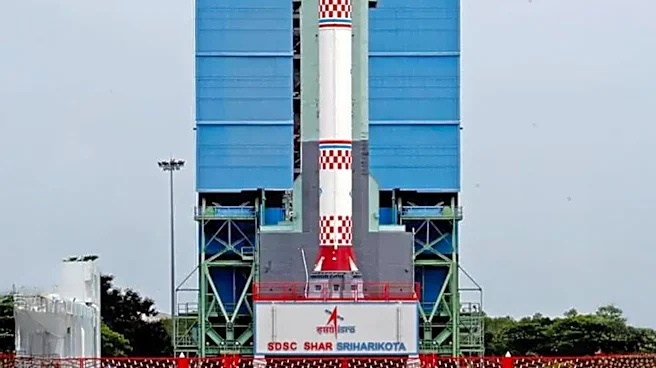
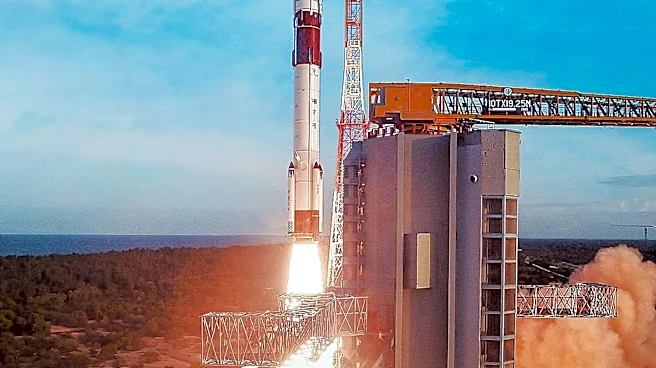
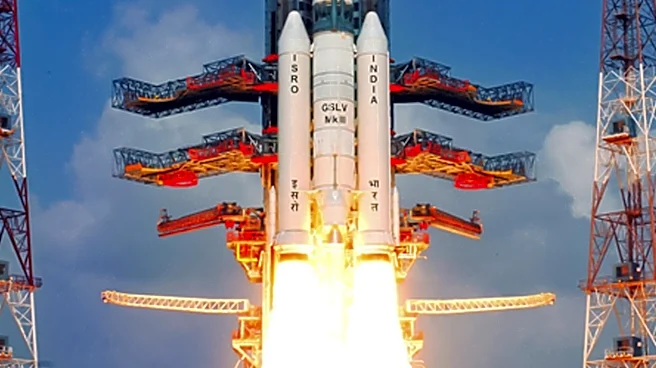
The Indian Space Research Organisation (ISRO) has successfully completed the flight acceptance test of a cryogenic engine for its forthcoming Geosynchronous Satellite Launch Vehicle (GSLV-F19) mission. This mission is slated to deploy the fourth navigation
satellite, NVS-04, which will serve both military and civilian applications. The test, conducted at the Propulsion Complex in Tamil Nadu, involved the ignition of both the main engine and the gas generator, with performance reported as normal and consistent with predictions during the 200-second duration. This indigenous cryogenic upper stage, which utilizes liquid hydrogen as fuel and liquid oxygen as an oxidizer at extremely low temperatures, is a critical component for placing satellites into their intended orbits efficiently. The GSLV-F19 mission is expected to take place in 2027, following ISRO's recent success in October with the GSLV-F18 mission, which placed the NVS-03 satellite into geosynchronous orbit.
Why It's Important?
This successful test signifies a crucial step in India's pursuit of self-reliance in advanced space technology, particularly in the development of cryogenic engines. The ability to indigenously produce and test such complex systems reduces dependence on foreign technology, a lesson learned from past restrictions on technology transfer. The upcoming launch of the NVS-04 satellite will further enhance India's Navigation with Indian Constellation (NavIC) system, providing real-time positioning, navigation, and timing services across the Indian landmass and an extended region up to 1,500 km beyond its borders. This system is vital for reducing reliance on foreign global positioning systems like the U.S.-owned GPS, thereby bolstering India's strategic autonomy and national security. The advancement in space technology also positions India as a significant player in the global space industry, potentially opening doors for international collaborations and commercial opportunities.
What's Next?
Following the successful flight acceptance test, the cryogenic engine will be integrated into the GSLV-F19 for the NVS-04 mission. While a specific launch date has not yet been announced by ISRO, it is anticipated to occur in 2027. The successful deployment of NVS-04 will further strengthen the NavIC system, expanding its coverage and improving its accuracy for various applications. ISRO will likely continue its rigorous testing and preparation phases for the GSLV-F19 mission. The ongoing development and successful execution of such missions are expected to contribute to India's long-term goals in space exploration and satellite technology, including its Gaganyaan human spaceflight program, which is reportedly in advanced stages of development with key systems and spacecraft components completed.
Beyond the Headlines
The mastery of cryogenic engine technology by ISRO has broader implications beyond immediate mission success. It represents a significant technological leap, placing India among a select group of nations capable of developing and utilizing such advanced propulsion systems. This capability is not only crucial for launching heavier satellites into higher orbits but also for future deep-space missions and human spaceflight endeavors. The emphasis on an indigenous navigation system like NavIC underscores a global trend among major powers to develop independent satellite navigation capabilities, driven by strategic and economic considerations. This move enhances national security and provides a robust infrastructure for various civilian applications, from transportation and disaster management to scientific research, fostering innovation and economic growth within the country's space sector.