





What's Happening?
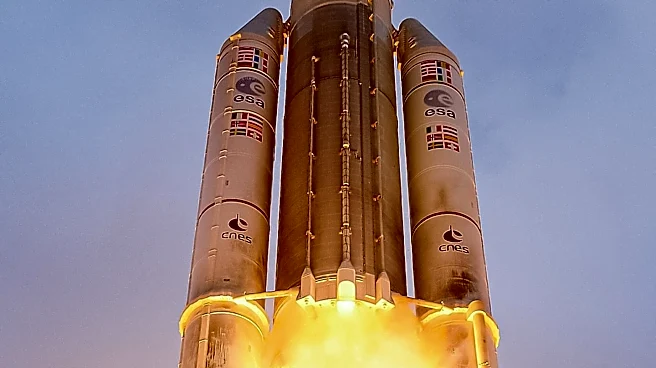
Europe is actively working to restore and expand its independent launch capabilities through the development and deployment of the Ariane 6 and Vega-C rockets. This initiative is part of a broader global trend where governments are increasingly relying
on commercial partners for space-related activities such as launch services, communications, and operations, while focusing their own efforts on science and exploration. The move comes as the global space sector experiences intensifying competition, driven by innovations like reusable launch systems and large satellite constellations, which are altering the economic landscape of access to orbit and broadband services. This strategic focus on autonomous launch capacity is crucial for Europe to maintain its competitive edge and ensure independent access to space in a rapidly evolving environment.
Why It's Important?
The development of Ariane 6 and Vega-C is vital for Europe's strategic autonomy in space. In an era where access to space is increasingly critical for national security, economic development, and scientific advancement, relying solely on other nations or commercial entities for launch services can pose significant risks. By investing in its own launch capabilities, Europe ensures that it can deploy its satellites and conduct its missions without external dependencies, safeguarding its interests and fostering technological sovereignty. This also stimulates the European space industry, creating jobs, driving innovation, and strengthening the continent's position in the global space economy. The ability to independently launch satellites is essential for various applications, including Earth observation, telecommunications, navigation, and scientific research, all of which have profound impacts on European society and economy.
What's Next?
The continued development and operationalization of Ariane 6 and Vega-C will be a key focus for Europe. Successful launches and consistent performance will be critical to establishing these rockets as reliable options in the competitive global market. Europe will likely continue to refine its strategies for commercial partnerships in space, balancing government-funded exploration with private sector innovation. The success of these programs could also influence future European space policy, potentially leading to further investments in advanced launch technologies, such as reusable systems, to remain competitive with other spacefaring nations and private companies. The ongoing evolution of the global space economy, with its emphasis on cost-effectiveness and frequent launches, will necessitate continuous adaptation and innovation from European space agencies and industries.
Beyond the Headlines
Beyond the immediate goal of autonomous launch, Europe's investment in Ariane 6 and Vega-C reflects a deeper commitment to maintaining its technological and industrial base in the high-tech space sector. This commitment extends to fostering a skilled workforce, supporting research and development, and ensuring that Europe remains a significant player in shaping the future of space exploration and utilization. The strategic importance of these launchers goes beyond mere transportation; they represent a cornerstone of European scientific ambition, economic competitiveness, and geopolitical influence. The ability to control its access to space allows Europe to pursue its own scientific agendas, contribute to international collaborations on its own terms, and protect its critical space infrastructure, thereby reinforcing its role as a global leader in science and technology.