





What's Happening?
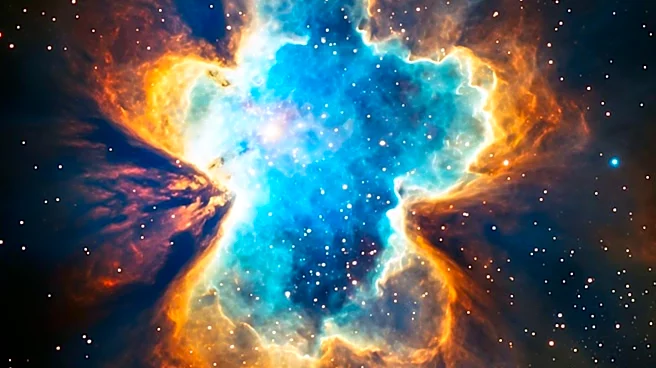
Astronomers have observed a unique phenomenon in the Milky Way, where clumps of gas, described as 'bullets,' are being ejected from a rare exploding star at speeds up to 20 million miles per hour. This event is linked to V445 Puppis, the galaxy's only
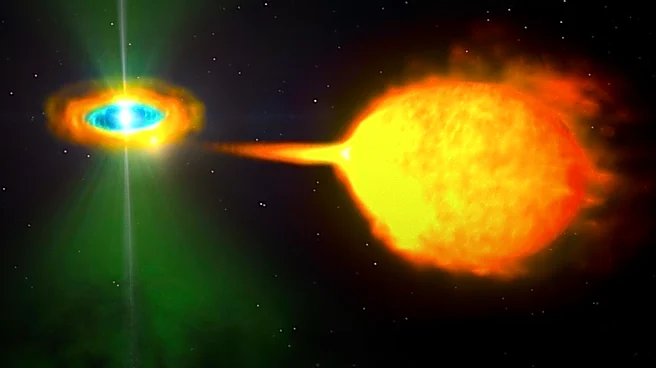
known helium nova, which was obscured by a dust cloud for over two decades. The explosion involves a white dwarf star accreting material from a helium star, leading to a thermonuclear explosion. This discovery allows scientists to study such rare stellar explosions more closely, providing insights into the processes that may lead to Type Ia supernovae, which are crucial for measuring cosmic distances.
Why It's Important?
The discovery of this rare stellar explosion is significant as it provides a new perspective on the processes leading to Type Ia supernovae, which are used as 'standard candles' to measure astronomical distances. Understanding these explosions can refine models of stellar evolution and the chemical enrichment of galaxies. The event also highlights the dynamic and sometimes violent nature of stellar interactions, offering a glimpse into the life cycles of stars and the complex mechanisms that govern their behavior. This could have implications for our understanding of the universe's expansion and the role of such explosions in cosmic evolution.
What's Next?
Astronomers will likely continue to monitor V445 Puppis and similar systems to gather more data on the mechanisms behind helium novae and their role in the broader context of stellar evolution. Further observations could help clarify the origins of the 'bullets' and their composition, potentially leading to new insights into the lifecycle of stars and the formation of supernovae. This ongoing research may also influence the development of new models for predicting and understanding stellar explosions across the universe.