
What's Happening?
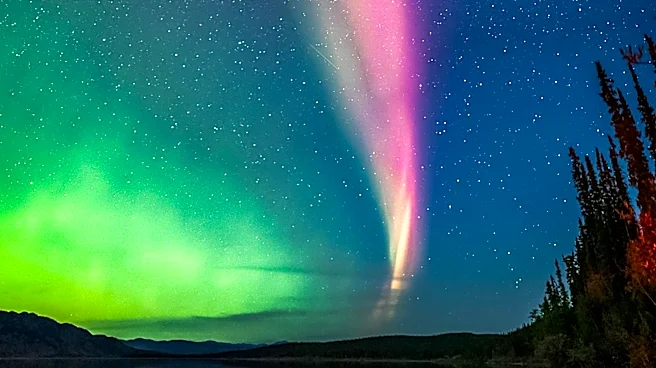
Astrophotographer Todd Salat captured a rare celestial event on November 14, 2026, featuring a conjunction of Mars and Jupiter, unexpectedly accompanied by an aurora over Alaska's Kenai Peninsula. The planets, appearing close together in the sky, rose
in the east around 1 a.m. (10:00 UTC), with Jupiter as a large white object and Mars as a reddish one. The auroras, described as a 'bonus,' were triggered by a short blast of negative B-sub-z solar wind. Salat noted that the auroras 'grabbed the mic and took over the show' once the planets climbed above the reflection zone. A planetary conjunction occurs when two planets appear near each other along the ecliptic, despite being millions of miles apart in space. Auroras, also known as northern lights (aurora borealis) or southern lights (aurora australis), are vibrant displays caused by energetic particles from space colliding with atoms and molecules in Earth's atmosphere.
Why It's Important?
This event highlights the dynamic and often unpredictable nature of space weather and celestial mechanics. For astrophotographers and skywatchers, the simultaneous occurrence of a planetary conjunction and an aurora is a particularly significant and visually stunning phenomenon. It underscores the beauty and complexity of our solar system and the Earth's interaction with solar activity. The event also serves as an educational opportunity, illustrating concepts such as planetary conjunctions, the ecliptic, and the science behind auroras. For the public, it offers a chance to appreciate the wonders of the night sky and the unique atmospheric conditions that make such displays possible in regions like Alaska, a state known for its aurora visibility.
What's Next?
While this specific conjunction and aurora event has passed, the ongoing study of planetary movements and space weather continues. Astrophotographers and scientists will continue to monitor and document similar celestial events. The data collected from such observations contributes to a deeper understanding of solar-terrestrial interactions and planetary dynamics. For those interested in skywatching, future planetary conjunctions and aurora forecasts will remain subjects of interest, encouraging continued engagement with astronomy and space science. The event also reinforces the importance of locations like the Kenai Peninsula for astrophotography due to its clear skies and northern latitude.
Beyond the Headlines
The convergence of a planetary conjunction and an aurora, as captured by Todd Salat, transcends mere observation; it represents a profound connection between human curiosity and the cosmos. Such events inspire not only scientific inquiry but also artistic expression and a sense of wonder. The 'bonus aurora' element underscores the serendipitous nature of astronomical observation, where unexpected phenomena can enhance planned viewing. This event also subtly highlights the role of citizen scientists and astrophotographers in documenting and sharing these natural spectacles, contributing to public awareness and appreciation of space science. It reinforces the idea that the universe is constantly active and full of surprises, encouraging a deeper engagement with our place within it.