



What's Happening?
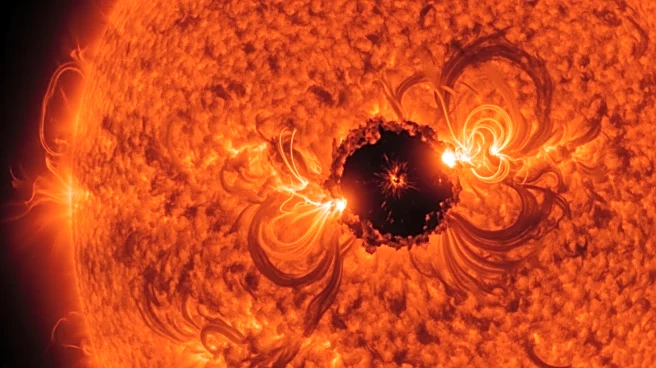
NASA's Solar Dynamics Observatory has recorded a significant solar flare eruption on January 18, 2026. The event was captured using the spacecraft's Atmospheric Imaging Assembly (AIA) 131-angstrom wavelength channel, which is designed to highlight extremely
hot material in solar flares. The video footage shows the flare as a bright flash near the center left of the Sun, colorized in teal. The timestamp in the video is in Coordinated Universal Time (UTC), which is five hours ahead of Eastern Standard Time. The video also presents the flare in three different wavelengths—131, 171, and 304 angstroms—colorized in teal, gold, and red, respectively. This comprehensive observation provides valuable data for understanding solar activity and its potential impacts on Earth.
Why It's Important?
Solar flares are powerful bursts of radiation that can have significant effects on Earth's space environment. They can disrupt satellite communications, navigation systems, and even power grids. Understanding solar flares is crucial for predicting space weather and mitigating its impacts on technology and infrastructure. The data collected by NASA's Solar Dynamics Observatory helps scientists analyze the behavior of solar flares and improve forecasting models. This particular observation contributes to ongoing research aimed at protecting critical systems from solar-induced disruptions, which is vital for maintaining the reliability of modern technological networks.
What's Next?
The data from this solar flare will be analyzed by scientists to better understand the mechanisms driving such eruptions. This analysis will contribute to the development of more accurate space weather prediction models. Additionally, NASA and other space agencies will continue to monitor solar activity closely, as the Sun approaches the peak of its 11-year solar cycle, expected around 2025. This period is characterized by increased solar activity, including more frequent and intense solar flares, making continuous observation and research essential for preparedness and response strategies.