



What's Happening?
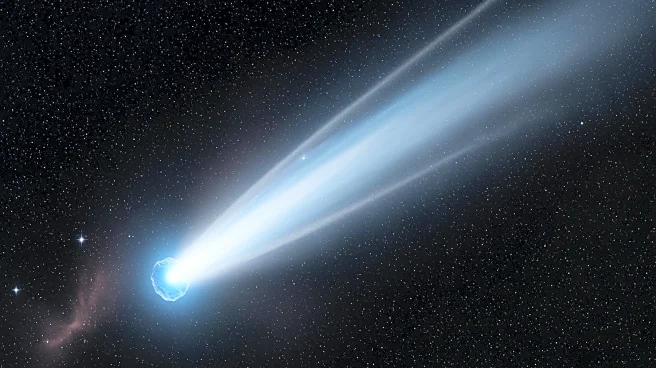
NASA's Asteroid Terrestrial-impact Last Alert System (ATLAS) has identified a rare interstellar comet, 3I/ATLAS, which recently made its closest approach to Earth on December 19, 2025. This comet, originating from outside our solar system, passed within
168 million miles of Earth, allowing scientists to gather valuable data. 3I/ATLAS is only the third confirmed interstellar object observed in our solar system, following 1I/ʻOumuamua in 2017 and 2I/Borisov in 2019. The comet's trajectory suggests it comes from the Milky Way's thick disk, indicating it could be as old as 7 billion years. During its approach, 3I/ATLAS exhibited unexpected behavior by brightening more rapidly than typical comets, a phenomenon that remains unexplained.
Why It's Important?
The observation of 3I/ATLAS provides a unique opportunity for scientists to study material from beyond our solar system, offering insights into the formation of planetary systems around other stars. The comet's ancient origin could help researchers understand the processes that occurred in the early universe. The data collected during its flyby will contribute to the study of interstellar objects and their role in the galaxy. This event underscores the importance of monitoring and studying celestial bodies that traverse our solar system, as they can reveal information about the broader cosmos and the history of our galaxy.
What's Next?
As 3I/ATLAS continues its journey out of the solar system, scientists will analyze the data collected during its passage. This research will focus on understanding the comet's composition, behavior, and origin. The findings could influence future studies of interstellar objects and enhance our knowledge of the Milky Way's thick disk. Additionally, the unexpected brightening of the comet may prompt further investigation into the physical processes affecting interstellar comets as they approach the sun.