




What's Happening?
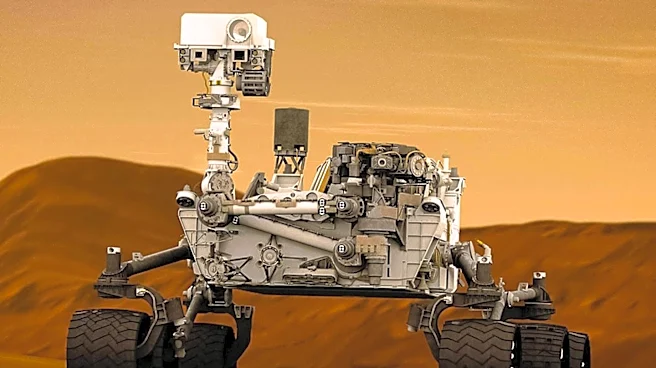
NASA's Curiosity rover captured a six-image panorama of Mount Sharp's yardang layer on Mars during dawn on August 11, 2026. The images, taken by the Mastcam at 8:30 a.m. local time on the mission's 4,982nd Martian day, provide the most detailed view to
date of these wind-carved rock formations. Mount Sharp, also known as Aeolis Mons, stands 3.4 miles (5.5 km) tall within Mars' 96-mile-wide (154 km) Gale Crater. Since 2014, Curiosity has ascended approximately 0.6 miles (1 km) up its stratified slopes, analyzing each geological layer. Scientists are particularly interested in the yardang layer because its color and orientation differ from the surrounding material, suggesting it may have formed from volcanic ash that was subsequently sculpted by wind. The Curiosity rover is expected to reach the base of this yardang layer in 2027 to conduct further investigations.
Why It's Important?
The detailed images and upcoming exploration of the yardang layer are crucial for understanding Mars' geological history and past environmental conditions. The distinct characteristics of the yardangs could provide evidence of ancient volcanic activity and wind erosion patterns, offering insights into how the Martian surface has evolved over millions of years. By studying these formations, scientists can piece together the planet's climatic past, including the presence of water and atmospheric dynamics. This research contributes to the broader goal of determining if Mars ever harbored life and identifying potential resources for future human missions. The continuous data collection by Curiosity, reading each layer like a 'chapter of Martian geology,' is vital for building a comprehensive geological timeline of the red planet, informing future robotic and human exploration strategies.
What's Next?
The Curiosity rover is scheduled to reach the base of the yardang layer in 2027. Once there, its instruments will be deployed to analyze the composition and structure of these formations, aiming to uncover how they were formed. This direct investigation will provide critical data to test the hypothesis that the yardangs originated from volcanic ash. The findings will contribute to a more complete understanding of Mars' geological processes and environmental history. The ongoing mission of Curiosity, along with data from other Mars missions, will continue to shape our understanding of the planet and guide the planning for future missions, including potential sample return efforts and human landings.
Beyond the Headlines
The exploration of Mars by rovers like Curiosity represents a profound human endeavor to understand our place in the cosmos and the potential for life beyond Earth. Beyond the scientific data, these missions inspire public interest in space exploration and foster technological innovation. The challenges of operating a rover on another planet, including navigating complex terrain and managing scientific instruments remotely, push the boundaries of engineering and robotics. The insights gained from studying Martian geology not only inform planetary science but also provide a comparative planetology perspective, helping us understand Earth's own geological processes and climate change. The long-term vision of Mars exploration, including the eventual goal of human settlement, relies heavily on the foundational knowledge gathered by missions like Curiosity, making each new discovery a step towards that ambitious future.