
What's Happening?
On December 19, 2025, Comet 3I/ATLAS made its closest approach to Earth, coming within approximately 168 million miles. This event has garnered significant attention from the scientific community, as it provides
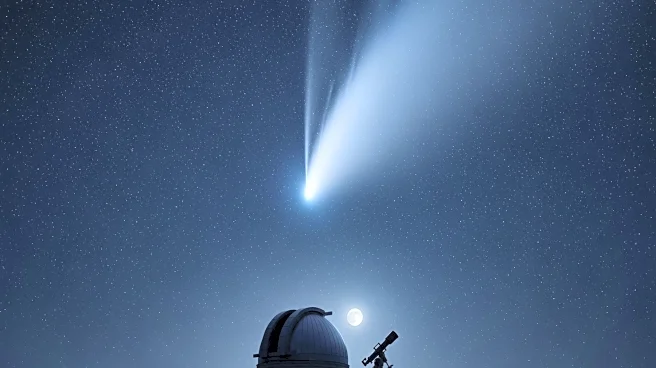
a rare opportunity to study an interstellar comet in detail. Discovered by astronomer Larry Denneau on July 1, 2025, using the ATLAS telescope in Chile, Comet 3I/ATLAS is the third large interstellar object recorded entering our solar system. During its close pass, astronomers have been able to observe its characteristics, such as a rotating gas and dust jet, which was detected at the Teide Observatory in Spain. The comet's spin period is estimated to be between 14-17 hours, aligning with typical comets found within our planetary system.
Why It's Important?
The close approach of Comet 3I/ATLAS is significant for astronomers and scientists as it allows for detailed study of an interstellar object, which can provide insights into the composition and behavior of celestial bodies from outside our solar system. Understanding such objects can enhance knowledge about the formation and evolution of the solar system and the universe. The data collected during this event could lead to breakthroughs in cometary science and improve predictive models for future interstellar visitors. Additionally, the public interest in such celestial events can boost support for space exploration and scientific research.
What's Next?
Following its closest approach, Comet 3I/ATLAS will continue its journey out of the solar system, moving beyond the reach of current observational capabilities. However, the data collected during its flyby will be analyzed by scientists to gain further insights into its composition and behavior. The Virtual Telescope Project hosted a live stream of the event, allowing the public to engage with the scientific community's efforts to study the comet. As the comet exits the solar system, astronomers will continue to monitor its trajectory and any potential interactions with other celestial bodies.