




What's Happening?
Orbital Matter, a German startup, has successfully 3D-printed a half-meter-long rigid beam in the vacuum of space using a custom plastic material. This achievement marks the first time a free-flying spacecraft in orbit has accomplished such a feat. The
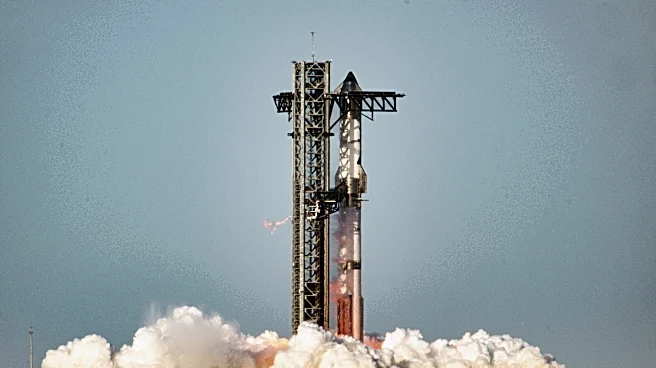
company's small satellite, Replicator-2, launched on a SpaceX rideshare mission with four 3D printers onboard. These printers create rigid, cylindrical beams by extruding resin coils cured by ultraviolet light. While two printers were designed to deploy a flexible solar array, one experienced an anomaly. However, the successfully created boom deployed the solar array, serving as a crucial proof of concept. Previous 3D-printing efforts in microgravity were confined to the pressurized environment of the International Space Station. Orbital Matter's CTO, Robert Ihnatisin, stated that the company prioritized learning in orbit and adapting software over extensive ground testing.
Why It's Important?
This breakthrough by Orbital Matter is significant for the future of space infrastructure and the U.S. space economy. The ability to construct large structures in orbit addresses critical challenges related to spacecraft size, electrical power generation, and heat dissipation. Future spacecraft, especially those intended as orbital data centers, will require larger capacities that are difficult to launch within current rocket fairing constraints. In-orbit manufacturing allows for the creation of larger components, potentially making power and heat management much more efficient. This technology could reduce the complexity and cost associated with deploying large solar arrays or telescope mirrors, which currently rely on intricate origami-like folding and deployment mechanisms. The success of this mission demonstrates a viable path toward more robust and adaptable space systems, benefiting U.S. companies and agencies involved in space exploration and commercialization.
What's Next?
Orbital Matter is planning another demonstration mission for 2028, which will test a larger version of its printer on a bigger satellite. The goal of this mission is to deploy a solar array capable of generating 5 kW of power, serving as a stepping stone towards larger deployments of 100+ kW per wing by 2030. The company is also collaborating with satellite builders to integrate its Printer-Assisted Deployment System (PADS) into their spacecraft for extending solar panels, antennas, and other components. This indicates a clear trajectory towards commercial application and integration of this technology into mainstream satellite manufacturing. Continued testing and refinement will be crucial to validate the long-term reliability and scalability of in-orbit 3D printing for various space applications.
Beyond the Headlines
The successful 3D printing in space by Orbital Matter represents a fundamental shift in how space assets could be designed, built, and maintained. This capability could lead to a future where spacecraft are no longer limited by launch vehicle dimensions but can be assembled and expanded in orbit. This has profound implications for the longevity and functionality of satellites, space stations, and even future lunar or Martian habitats. It also raises questions about the regulation and ownership of in-space manufacturing capabilities, potentially fostering new legal and economic frameworks for off-Earth industrial activities. The ability to repair, upgrade, or even recycle components in space could significantly reduce the amount of space debris and enhance the sustainability of space operations, contributing to a more resilient and adaptable presence beyond Earth.