







What's Happening?
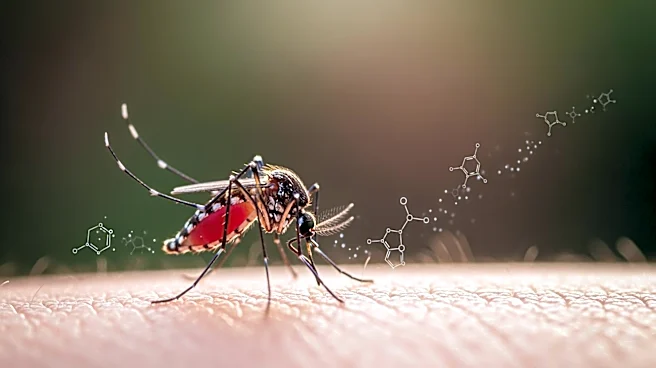
Recent scientific studies have shed light on why certain individuals are more attractive to mosquitoes than others. Researchers have identified that mosquitoes are drawn to humans based on a combination of sensory cues, including body odor, heat, and
carbon dioxide exhalation. The study, led by Frederic Simard from France's Institute of Research for Development, highlights that while carbon dioxide is the initial attractant, body odor plays a significant role as mosquitoes get closer. The research also debunks common myths, such as the preference for certain blood types, and instead points to specific compounds in body odor as key attractants. The findings are crucial as they help understand mosquito behavior, which is vital for controlling diseases like malaria and dengue.
Why It's Important?
Understanding mosquito attraction is critical for public health, especially as climate change expands the habitats of disease-carrying mosquitoes. This research could lead to more effective mosquito control strategies, potentially reducing the spread of diseases like malaria, dengue, and chikungunya. By identifying the specific compounds that attract mosquitoes, new repellents or treatments could be developed to make individuals less appealing to these insects. This is particularly important in regions where mosquito-borne diseases are prevalent and pose significant health risks.
What's Next?
Future research may focus on developing targeted repellents that neutralize the specific compounds identified as attractants. Additionally, public health campaigns could incorporate these findings to educate communities on how to reduce mosquito bites, such as by avoiding certain activities or substances that increase attractiveness to mosquitoes. As the range of mosquitoes expands due to climate change, these strategies will become increasingly important in preventing outbreaks of mosquito-borne diseases.