



What's Happening?
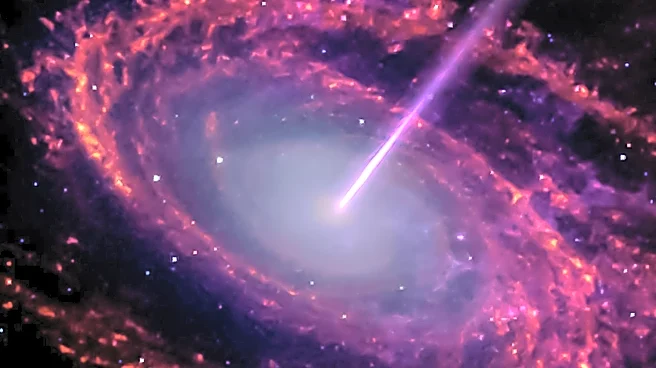
Astronomers have identified three actively feeding supermassive black holes within a single galaxy, J0148-4214, located approximately 12.5 billion light-years from Earth. This discovery, led by a research team from the Max Planck Institute for Extraterrestrial
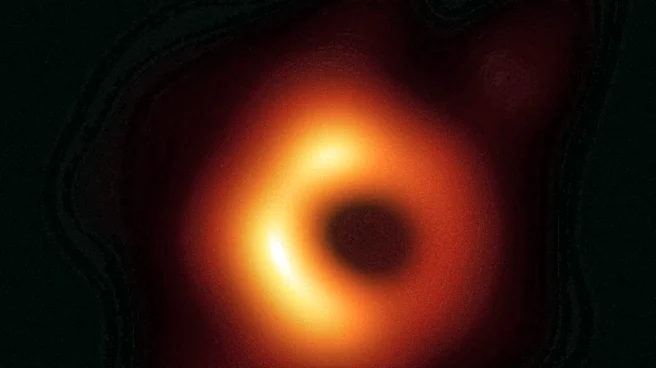
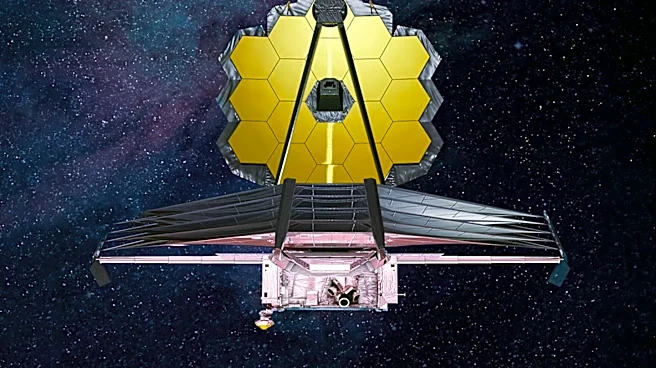
Physics (MPE), provides insights into the early universe, observing the galaxy as it existed just 1.2 billion years after the Big Bang. Two of these black holes are situated near the galaxy's center, separated by about 620 light-years, while the third is further out, approximately 5,500 light-years from the core. The black holes are actively accreting matter, which spirals into them from surrounding gas and material disks. The detection was made possible by examining distinctive patterns in the light emitted by hydrogen gas, which is influenced by the strong gravitational forces near black holes. The James Webb Space Telescope (JWST) played a crucial role in this discovery, particularly its Near Infrared Spectrograph (NIRSpec-IFS) integral field spectroscopy mode, which allowed researchers to differentiate signals that would otherwise appear as a single source.
Why It's Important?
This finding is significant as it offers direct evidence of how massive black holes formed and interacted in the early universe. The presence of three active black holes in one ancient galaxy suggests that processes in the early cosmos were highly efficient at bringing these massive objects together, setting the stage for subsequent mergers. Such mergers are believed to be a primary mechanism for the rapid growth of supermassive black holes shortly after the Big Bang. The varying masses of the discovered black holes—approximately 80 million, 600,000, and 2 million times that of the Sun—and their differing accretion rates, particularly the unusually rapid growth of the 600,000-solar-mass black hole, challenge existing models of black hole growth. This observation could lead to a revised understanding of how some black holes achieved enormous sizes within the relatively short timeframe available in the early universe, impacting theories of cosmic evolution and galaxy formation.
What's Next?
The two central black holes in J0148-4214 are projected to merge within the next few hundred million years, a process that could result in an even more massive black hole. This impending merger offers a unique opportunity to study the mechanisms behind the growth of cosmic giants. Researchers will continue to analyze data from the James Webb Space Telescope to identify more such hidden systems, as the current discovery suggests that many distant galaxies may harbor multiple growing black holes that have previously gone undetected. Further observations and theoretical modeling will aim to refine our understanding of black hole merging processes and their contribution to the rapid growth of supermassive black holes in the early universe. The third black hole's location, potentially a remnant of an earlier merger or gradually moving towards the center, will also be a focus of future study to understand its trajectory and potential interactions.
Beyond the Headlines
The discovery of multiple active black holes in a single, distant galaxy has profound implications for our understanding of the universe's fundamental structure and evolution. It highlights the dynamic and often violent nature of the early cosmos, where galaxy collisions and black hole mergers were likely common occurrences. This research pushes the boundaries of observational astronomy, demonstrating the unparalleled capabilities of instruments like the James Webb Space Telescope in peering back to the universe's infancy. The existence of black holes growing at rates exceeding theoretical predictions (the Eddington limit) suggests that our current models of black hole accretion may be incomplete or require significant adjustments. This could lead to new theoretical frameworks that better explain the rapid assembly of mass in the early universe, potentially influencing our understanding of dark matter and dark energy interactions, and the overall cosmic web formation.