





What's Happening?
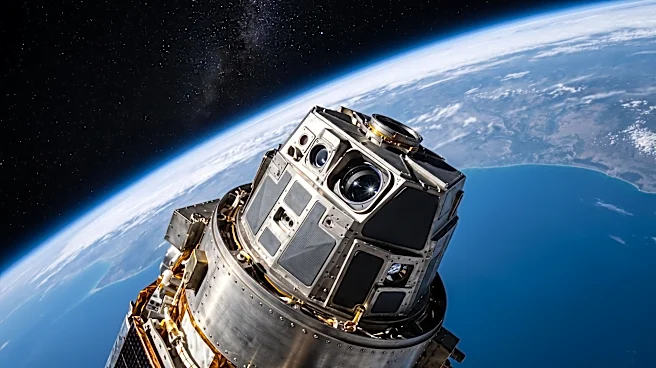
New research evaluates the information loss in submillimetre-wave atmospheric sounding, specifically focusing on the impact of sideband asymmetry in double-sideband (DSB) detection. Microwave and submillimetre radiometric sounders typically use DSB detection,
which combines signals from both lower and upper sidebands into a single channel. The study analytically demonstrates that when the observation sensitivities (Jacobians) of the two sidebands differ, information is lost compared to direct detection (DD), which samples these bands independently. This loss is quantified by comparing the retrieval errors of temperature, water vapor, and relative humidity at various frequencies. At the 368.49 GHz oxygen band, where sideband asymmetry is pronounced due to a nearby water-vapor line, DSB retrieval errors significantly exceed those of DD, particularly between 2 and 10 km altitude.
Why It's Important?
This research is crucial for the U.S. scientific community and agencies involved in atmospheric monitoring and climate research, such as NOAA and NASA. Accurate atmospheric sounding is vital for weather forecasting, climate modeling, and understanding atmospheric composition. The identified information loss in DSB detection means that current submillimetre sounders might be providing less precise data than possible, especially for critical parameters like water vapor and temperature at certain altitudes. Improving the accuracy of these measurements can lead to more reliable weather predictions, better climate models, and a more comprehensive understanding of atmospheric processes, which has direct implications for disaster preparedness, agricultural planning, and long-term climate strategies.
What's Next?
The findings provide a quantitative basis for choosing detection schemes for future submillimetre sounders. Researchers and instrument developers will need to consider the trade-offs between DSB and DD, particularly in frequency bands where sideband asymmetry is significant. This may lead to the development of new sounder designs that incorporate DD or advanced signal processing techniques to mitigate information loss in DSB systems. Further research will likely focus on optimizing detection schemes, refining retrieval algorithms, and exploring the practical implementation challenges and benefits of DD in operational atmospheric sounding missions. The goal will be to maximize the accuracy and utility of atmospheric data for scientific and societal applications.
Beyond the Headlines
The study delves into the fundamental physics of remote sensing, highlighting how instrumental design choices can profoundly impact the quality and completeness of scientific data. The concept of 'information loss' due to technical limitations, even in highly advanced instruments, underscores the continuous need for innovation and critical evaluation in scientific measurement. This research could also influence other fields that rely on similar spectroscopic techniques, prompting a re-evaluation of data acquisition methods. Ultimately, it contributes to the broader scientific endeavor of pushing the boundaries of observational capabilities to gain a more accurate and detailed understanding of our planet's complex systems.