





What's Happening?
Ukraine is significantly advancing its battlefield logistics through innovative uses of unmanned aerial vehicles (UAVs) and unmanned ground vehicles (UGVs). The Ukrainian defense ministry and the Brave1 defense technology cluster are encouraging novel
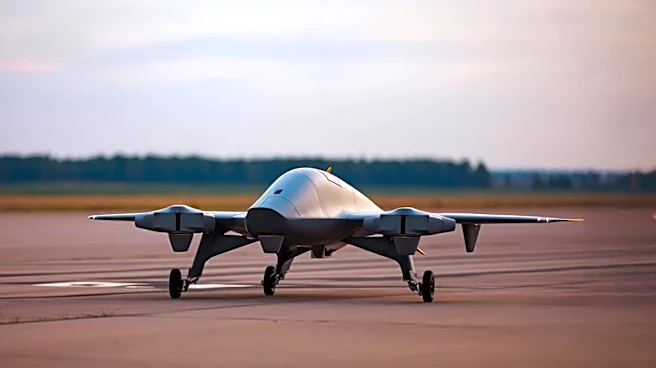
approaches to reduce risks to military personnel. One key innovation is the use of UAVs for casualty evacuation (casevac). For instance, the 30th Separate Mechanized Brigade successfully airlifted a seriously wounded soldier using a modified 'Ayudag-6' hexacopter. Additionally, drone specialists from Ukraine's 475th Separate Assault Regiment, Code 9.2, in collaboration with 'Skyfall,' developed the 'StarGate' UAV, capable of carrying up to 150 kilograms at 150 kph, equipped with AI-enhanced guidance for electronic warfare environments. This system has already successfully evacuated two seriously wounded soldiers from inaccessible 'gray zones.' Furthermore, Ukraine is deploying amphibious UGVs to overcome water obstacles like rivers and marshes, which previously limited ground robot operations. The 'Alter Ego' unit of the 93rd Separate Mechanized Brigade successfully completed a 40-kilometer combat mission over land and water, delivering supplies and ammunition.
Why It's Important?
These innovations in logistics support are critical for Ukraine's war effort, directly addressing the challenges of operating in high-risk combat zones and reducing casualties. The ability to evacuate wounded soldiers from inaccessible areas using UAVs can significantly improve survival rates and morale among frontline troops. The development of AI-enhanced drones capable of operating in dense electronic warfare environments demonstrates Ukraine's technological adaptability and its commitment to leveraging advanced solutions. The introduction of amphibious UGVs solves a major logistical hurdle, enabling the delivery of supplies and ammunition across diverse terrains, including water bodies, which were previously impassable for ground robots. These advancements not only enhance operational efficiency but also protect human lives by automating dangerous tasks, showcasing Ukraine's strategic focus on technological superiority in logistics.
What's Next?
Ukraine is expected to further integrate and expand the deployment of these advanced unmanned systems across its forces. The success of initial missions with casevac UAVs and amphibious UGVs will likely lead to increased production and wider adoption. The Brave1 defense technology cluster will continue to foster collaboration between military units and manufacturers to develop more sophisticated and specialized unmanned platforms. Future developments may include increased payload capacities, extended ranges, enhanced autonomy, and improved resistance to countermeasures. The operational effectiveness of these systems will also likely influence military doctrines and training, emphasizing remote operations and robotic support for frontline units. This ongoing innovation could set new standards for battlefield logistics in modern warfare.
Beyond the Headlines
Ukraine's rapid adoption and innovation in unmanned logistics systems highlight a broader paradigm shift in military operations, where technology is increasingly used to mitigate human risk and overcome environmental challenges. This approach not only saves lives but also allows for more flexible and resilient supply chains in dynamic combat environments. The collaboration between military units and private defense technology companies, facilitated by initiatives like Brave1, demonstrates a model for rapid technological development and deployment in wartime. This could have long-term implications for defense industries globally, emphasizing agility, innovation, and the integration of commercial technologies into military applications. Furthermore, the successful use of these systems could influence future international military aid and cooperation, with a focus on providing advanced technological solutions rather than just traditional weaponry.