
What's Happening?
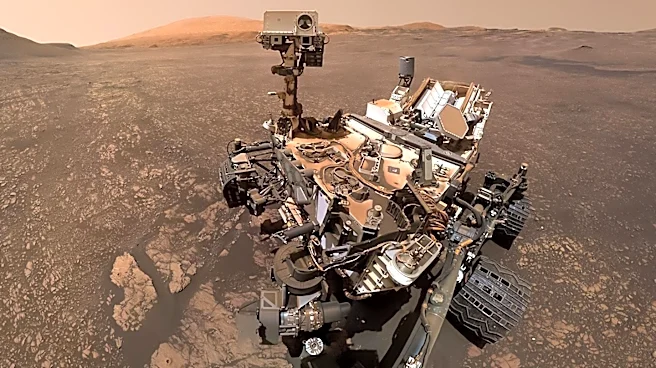
NASA's Curiosity rover, in 2024, uncovered significant deposits of pure elemental sulfur in Mars's Gale Crater's Gediz Vallis Channel. This discovery occurred when the rover's weight caused an unremarkable
rock to burst open, revealing pale yellow crystals. While sulfates are common on Mars, this marks the first time pure elemental sulfur, often referred to as brimstone, has been found on the planet. The surrounding area was also found to be littered with similar sulfur-rich rocks, covering an area of approximately 2,100 square meters. Scientists, including planetary scientist Scott VanBommel of Washington University in St. Louis and geochemist Jeff Berger of NASA's Johnson Space Center, have since published two studies in Science and Geophysical Research Letters in June and July 2026, respectively, to explain the formation of these deposits. The purity and fragility of the sulfur suggest it formed in situ, with one theory proposing it originated from volcanic gases trapped in ice clathrates, later exposed by erosion. Another study suggests a chemical reaction in acidic water between dissolved sulfide and chlorate could produce elemental sulfur without high temperatures or biological involvement.
Why It's Important?
The discovery of pure elemental sulfur on Mars is significant because it challenges existing geological models of the Red Planet. On Earth, large deposits of pure sulfur are typically associated with high-temperature volcanic or hydrothermal activity, conditions not evident in the Gediz Vallis. This finding suggests that there are important gaps in our understanding of Mars's geological history and the processes that shaped its surface billions of years ago. The presence of sulfur, an essential element for all life, also adds another layer to the ongoing search for past or present life on Mars. While the studies indicate that non-biological processes could explain the sulfur's formation, the continuous discovery of elements and conditions conducive to life on Mars, such as chemistry, water, and past habitable environments, keeps the scientific community engaged in exploring the planet's potential for life. Mars offers a unique 'frozen snapshot' of ancient planetary evolution, providing clues that could inform our understanding of Earth's own early development.
What's Next?
Further research will likely focus on refining the models for how pure elemental sulfur could have formed on Mars, particularly in the absence of high-temperature volcanic activity at the site. Scientists will continue to analyze data from the Curiosity rover and potentially future missions to gather more evidence to support or refute the proposed theories involving volcanic gases trapped in ice clathrates or chemical reactions in ancient Martian water. The ongoing exploration of Mars will also continue to seek other 'bits and pieces' that living organisms would find useful, aiming to build a more complete picture of the planet's habitability over its history. Understanding these geological and chemical processes is crucial for future human missions to Mars and for identifying potential biosignatures.
Beyond the Headlines
The discovery of pure elemental sulfur on Mars has broader implications beyond geology and astrobiology. It highlights the dynamic and often surprising nature of planetary science, where new data can fundamentally alter long-held scientific understandings. The fact that Mars, a seemingly barren world, continues to reveal complex chemical and geological phenomena underscores the vast unknowns in our solar system. This finding could also influence the design and objectives of future Mars missions, potentially leading to instruments specifically designed to detect and analyze similar unexpected chemical compositions. Furthermore, the comparison between Mars's geological evolution and Earth's early history provides a unique natural laboratory for understanding planetary development, offering insights into how life might emerge and persist under diverse conditions, even if Mars itself never harbored life.