




What's Happening?
Senator Jack Reed, the leading Democrat on the Senate Armed Services Committee, has strongly criticized President Trump's decision to significantly reduce the scale of joint military exercises between the United States and South Korea. Reed labeled the decision as 'stupid
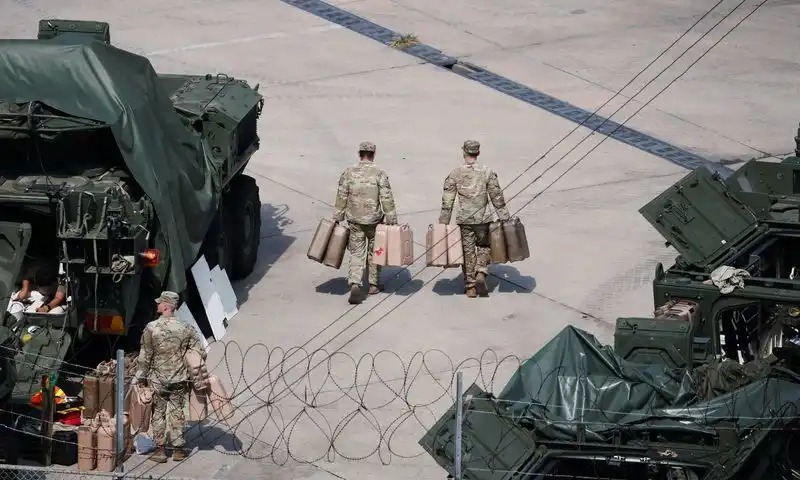
and incoherent,' expressing concern that it undermines American alliances. President Trump announced on Sunday a 'considerable reduction' in U.S. participation in the annual military drills, which commenced hours later. He cited his 'very good relationship with Kim Jong Un,' the North Korean leader, as a primary reason. South Korean authorities, however, confirmed that the joint maneuvers began as scheduled. President Trump also mentioned Seoul's non-participation in U.S. military operations against Iran as a justification for decreasing U.S. involvement in the exercises. Senator Reed argued that such actions make America's commitments appear negotiable to both allies and adversaries.
Why It's Important?
This decision by President Trump carries significant implications for U.S. foreign policy and national security in the Indo-Pacific region. Reducing military exercises with a key ally like South Korea could be perceived as a weakening of the U.S. commitment to regional security, potentially emboldening adversaries like China and Russia. Senator Reed highlighted this concern, stating that these nations are observing how easily President Trump abandons allies. Furthermore, the move could strain the long-standing alliance between the U.S. and South Korea, which is crucial for maintaining stability on the Korean Peninsula. The rationale provided by President Trump, linking the reduction to his relationship with Kim Jong Un and South Korea's stance on Iran, suggests a transactional approach to alliances that could destabilize existing security frameworks and create uncertainty among U.S. partners globally. This could lead to a re-evaluation of alliances and defense strategies by other nations reliant on U.S. security guarantees.
What's Next?
The immediate future will likely see continued debate and scrutiny from U.S. lawmakers and international observers regarding the implications of this decision. Senator Reed's strong condemnation suggests that the issue will remain a point of contention within Congress, potentially leading to calls for clarification or a re-evaluation of U.S. defense posture in the region. Allies in Asia, particularly South Korea and Japan, will be closely monitoring the situation for any further shifts in U.S. policy. The reduction in exercises could prompt South Korea to consider adjustments to its own defense strategy or seek alternative security arrangements. Additionally, North Korea and other regional actors will likely interpret this development, potentially influencing their own geopolitical calculations and actions. The long-term impact on regional stability and the effectiveness of U.S. alliances will depend on subsequent diplomatic efforts and military planning.
Beyond the Headlines
Beyond the immediate military and political ramifications, this decision touches upon the broader philosophical underpinnings of U.S. foreign policy. Senator Reed's assertion that President Trump's actions make U.S. commitments seem 'negotiable' raises fundamental questions about the reliability and predictability of American leadership on the global stage. This could foster a sense of insecurity among allies who have historically relied on consistent U.S. support. The linking of military exercises to personal relationships with authoritarian leaders, as seen with Kim Jong Un, and to unrelated foreign policy stances, such as South Korea's position on Iran, introduces a new and potentially volatile dynamic into international relations. This approach could erode the institutional foundations of alliances, replacing them with more fluid and personality-driven arrangements, which may prove less stable and predictable in times of crisis. The long-term consequence could be a fragmentation of global security architectures and a more multipolar world order.