





What's Happening?
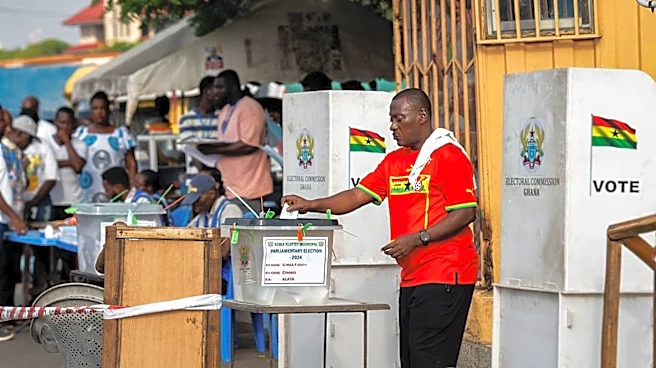
Ghana has formally expressed its intention to join the BRICS organization, with its Foreign Minister Samuel Okudzeto Ablakwa announcing cabinet approval for the decision during a press conference with India’s External Affairs Minister S. Jaishankar. Ghana is seeking
India's support for its membership bid. Ablakwa emphasized that Ghana's interest in BRICS is driven by a desire to diversify economic relations and expand its geopolitical and economic frontiers in a rapidly evolving multipolar world, rather than being directed against any existing partners. He stated that Ghana values its traditional relationships but seeks new alliances. India's External Affairs Minister S. Jaishankar responded sympathetically to Ghana's aspirations, highlighting both nations' historical roles as 'champions of the Global South.' BRICS+ currently comprises 10 member countries and 11 partner countries, accounting for nearly half of the global population and 40% of global GDP. If Ghana joins, it would be the fourth African nation in the bloc, following South Africa, Egypt, and Ethiopia.
Why It's Important?
Ghana's pursuit of BRICS membership signifies a broader trend among developing nations to seek alternative economic and geopolitical alignments beyond traditional Western-dominated structures. This move reflects a strategic effort to enhance economic options and leverage new platforms for development and influence. For the U.S., this development indicates a potential shift in global economic power dynamics and influence, as more countries explore non-Western partnerships. The expansion of BRICS could dilute the influence of existing international financial institutions and trade blocs where the U.S. holds significant sway. It also highlights the growing importance of the Global South in shaping future international relations and economic policies. The emphasis on diversification by Ghana suggests a desire for greater autonomy and resilience in its foreign policy and economic strategy, which could lead to new trade routes, investment opportunities, and diplomatic alignments that may not always align with U.S. interests.
What's Next?
Ghana will proceed with its formal application for BRICS membership, likely engaging in diplomatic discussions with current member states to garner support. India's expressed sympathy suggests it will advocate for Ghana's inclusion. The process of admission into BRICS involves consensus among existing members, so Ghana will need to secure approval from all current members. Other countries, like Nigeria, have adopted a 'middle of the road' approach, opting for partner status or membership in the New Development Bank (NDB) without full BRICS membership. Ghana's policymakers may consider similar options if full membership proves challenging or if they wish to maintain a more flexible stance. The NDB, the multilateral lending arm of BRICS, is a significant draw for many aspiring members, offering financing for infrastructure projects, often in local currencies. Future BRICS summits will likely feature discussions on Ghana's application and the potential for further expansion of the bloc.
Beyond the Headlines
Ghana's decision underscores a fundamental re-evaluation of international alliances by many nations in the current multipolar world. It challenges the traditional binary view of global alignment (pro-West or anti-West), instead emphasizing economic pragmatism and national interest. This move reflects a desire to hedge against geopolitical risks and economic dependencies by fostering diverse partnerships. The growing appeal of BRICS, driven by economic factors like access to the NDB and opportunities for trade in local currencies, suggests a long-term shift in global economic architecture. This could lead to a more fragmented international system where multiple centers of power coexist, potentially reducing the singular dominance of any one economic or political bloc. The emphasis on 'freedom of choice' and 'diversifying economic relations' by Ghana signals a strategic autonomy that many developing nations are increasingly seeking, which could reshape global trade patterns, investment flows, and diplomatic engagements in the coming decades.