


What's Happening?
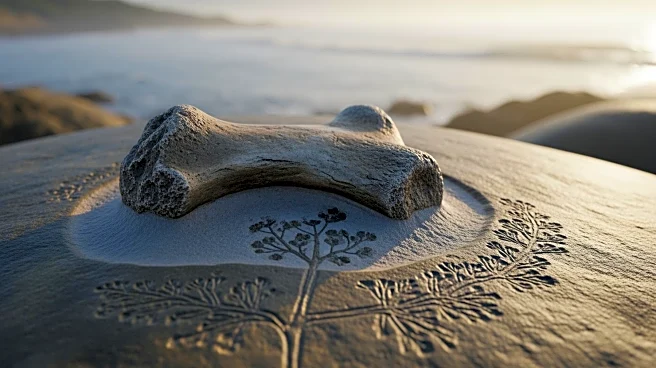
A jawbone discovered at the bottom of the Taiwan Strait has been identified as belonging to a Denisovan, a mysterious human ancestor. This fossil, found at depths of 60 to 120 meters, challenges previous beliefs that Denisovans only inhabited cold, mountainous
regions. The jawbone suggests that Denisovans also lived in warmer climates, expanding their known range. The identification was made using paleoproteomics, a method that analyzes proteins in ancient bones, providing a new way to confirm species when DNA is unavailable. This discovery adds to the understanding of Denisovan adaptability and their ability to thrive in diverse environments.
Why It's Important?
The discovery of the Denisovan jawbone in a warmer climate region like the Taiwan Strait significantly alters the understanding of Denisovan habitats. It suggests that Denisovans were more adaptable than previously thought, capable of surviving in both cold and warm climates. This adaptability could have implications for understanding human evolution and migration patterns. The use of paleoproteomics in this discovery also highlights a new frontier in archaeological research, offering a method to study ancient species where DNA analysis is not feasible. This could lead to more discoveries about ancient human relatives and their interactions with other species.
What's Next?
Future research will likely focus on further exploring the Taiwan Strait and similar regions for additional Denisovan fossils. The use of paleoproteomics could be expanded to other archaeological sites, potentially leading to more discoveries about Denisovan life and their interactions with other human species. Researchers may also attempt to date the fossil more precisely, which could provide insights into the timeline of Denisovan habitation in the region. This discovery could prompt a reevaluation of other sites where Denisovans might have lived, broadening the scope of human evolutionary studies.