







What's Happening?
Scientists at Northwestern University have identified a specific group of neurons in the central nucleus of the amygdala that appear to be connected to anxiety-like behavior induced by cannabinoids in stressful situations. The study, published on October
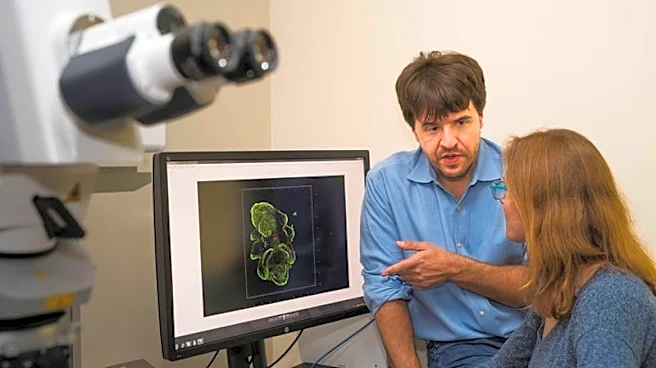
2 in the journal Nature Communications, involved experiments with mice. Researchers exposed mice to a threatening odor, derived from fox urine, after administering either a placebo or a synthetic cannabinoid drug. The mice that received the cannabinoid exhibited increased freezing behavior and reduced exploration of the odor source, indicating heightened anxiety. This behavioral response was correlated with elevated activity in the somatostatin neurons located within the central nucleus of the amygdala, a brain region known for its role in processing fear and stress. During the experiments, different doses of the cannabinoid drug were given to the mice, and their responses, including time spent near the odor, freezing, and escape behaviors, were meticulously recorded. Brain activity was monitored using a small microscope surgically implanted in the animals' brains.
Why It's Important?
This research is important because it sheds light on the neurological mechanisms through which cannabinoids can influence anxiety, particularly in stressful contexts. Understanding the specific neural pathways involved, such as the somatostatin neurons in the amygdala, could have significant implications for both therapeutic and recreational use of cannabis and cannabinoid-based products. For the U.S. healthcare industry, this could lead to the development of more targeted treatments for anxiety disorders, potentially mitigating adverse psychological effects associated with cannabinoid use. It also highlights the need for careful consideration of cannabinoid dosages and individual susceptibility, especially for individuals prone to anxiety or those in high-stress environments. The findings contribute to a more nuanced understanding of the brain's response to cannabinoids, which is crucial as cannabis legalization and medical applications continue to expand across the U.S., impacting public health and regulatory policies.
What's Next?
Future research will likely focus on further elucidating the precise molecular and cellular mechanisms by which cannabinoids activate these specific somatostatin neurons and how this activation translates into anxiety-like behaviors. Scientists may explore whether these findings in mice translate to humans, potentially through neuroimaging studies or clinical trials. This could lead to the identification of biomarkers for cannabinoid-induced anxiety or the development of pharmacological interventions to modulate the activity of these neurons. The findings could also inform public health guidelines regarding cannabinoid use, particularly for vulnerable populations. Additionally, pharmaceutical companies may investigate novel drug targets based on these neural pathways to create safer and more effective anxiolytics or to develop cannabinoid formulations with reduced anxiogenic side effects. The study's insights could also influence regulatory discussions around the potency and composition of cannabinoid products available to consumers.
Beyond the Headlines
The study's implications extend beyond immediate medical applications, touching upon broader societal and ethical considerations surrounding cannabinoid use. As cannabis becomes more accessible, understanding its potential to exacerbate anxiety under stress is critical for public education and responsible consumption. This research underscores the complexity of brain function and the intricate interplay between neurochemistry and behavior, challenging simplistic views of cannabinoids as universally beneficial or harmful. Ethically, the findings raise questions about informed consent for cannabinoid users, particularly those with pre-existing anxiety conditions or those in high-stress professions. It also highlights the ongoing need for rigorous scientific research to guide policy decisions in the rapidly evolving landscape of cannabis legalization and medical application, ensuring that public health and safety remain paramount. The study contributes to a deeper scientific understanding of the brain's stress response system and how external substances can modulate it.