



What's Happening?
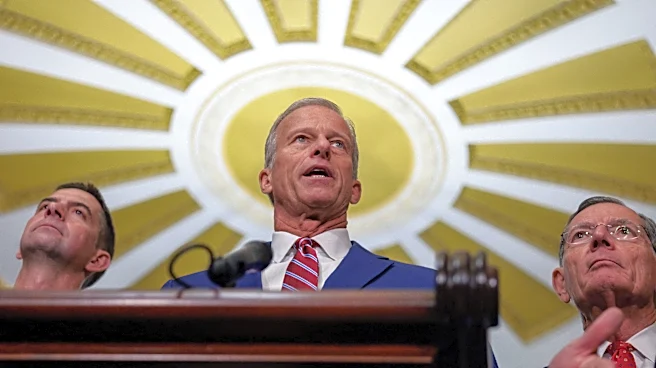
U.S. Senator Ted Cruz (R-Texas), Chairman of the Senate Committee on Commerce, Science, and Transportation, has led a letter to the Presidential Commission on the United States Space Academy, endorsing Texas’s proposal to host the new institution. The
letter, co-signed by Senator John Cornyn (R-Texas) and 23 other members of the Texas congressional delegation, argues that Texas possesses the necessary resources, infrastructure, and historical expertise in human spaceflight to support the President's vision for the academy. They emphasize Texas's six-decade leadership in human spaceflight, citing NASA's Johnson Space Center as home to America's astronaut corps, Mission Control, and human spaceflight training. The delegation asserts that locating the Space Academy in Texas would leverage existing investments and provide students with direct access to the people, facilities, and institutions driving America's space program.
Why It's Important?
The endorsement from Senator Cruz and the Texas delegation is a significant political maneuver aimed at securing a prestigious national institution for the state. Hosting the U.S. Space Academy would bring substantial economic benefits to Texas, including job creation, increased investment in aerospace and technology sectors, and enhanced educational opportunities. It would further solidify Texas's role as a leader in the U.S. space enterprise, attracting top talent and fostering innovation. For the nation, the decision on where to locate the Space Academy will have long-term implications for the development of its future space workforce and technological capabilities. The argument that Texas can build upon existing infrastructure rather than requiring new investments elsewhere highlights a cost-effective and strategically sound approach, potentially influencing the Presidential Commission's decision. This initiative underscores the competitive nature among states to attract federal projects that promise economic growth and national prestige.
What's Next?
The Presidential Commission on the United States Space Academy will now consider Texas's proposal, along with submissions from other states. The Commission's decision will likely involve a thorough evaluation of each proposal's merits, including infrastructure, educational partnerships, economic impact, and alignment with the President's vision for the academy. Following the Commission's review, a recommendation will be made, ultimately leading to the selection of the host state. The Texas delegation will likely continue to advocate for their state's bid, highlighting its unique advantages and historical contributions to space exploration. The selection process will be closely watched by political leaders, aerospace industries, and educational institutions across the country, as the chosen location will become a central hub for future space education and innovation.
Beyond the Headlines
The push to host the U.S. Space Academy in Texas reflects a broader national strategy to maintain and advance America's leadership in space. Beyond the immediate economic and educational benefits, the establishment of such an academy is crucial for cultivating the next generation of space professionals, from astronauts and engineers to scientists and policymakers. The emphasis on combining rigorous technical education with leadership development and public service underscores a holistic approach to space exploration, recognizing that future challenges will require not only scientific prowess but also strong ethical and strategic guidance. The competition among states for this academy also highlights the decentralized yet interconnected nature of the U.S. space industry, with various regions contributing unique strengths. The chosen location will not only be a center of learning but also a symbol of national ambition and commitment to pushing the boundaries of human endeavor in space.