


What's Happening?
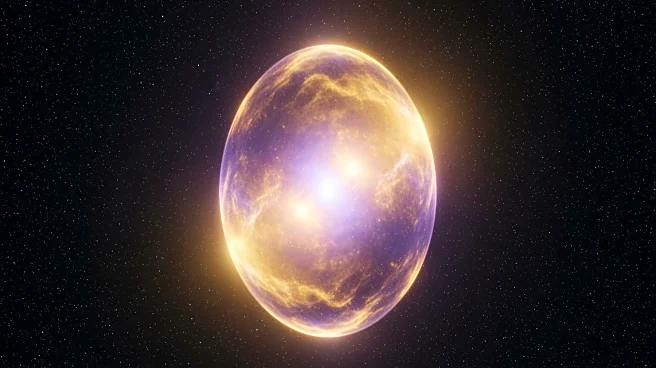
The Hubble Space Telescope has captured a new image of the Egg Nebula, a pre-planetary nebula located 1,000 light-years away in the constellation Cygnus. This nebula is significant as it represents one of the earliest stages of a planetary nebula, providing
astronomers with a rare glimpse into the transitional phase of a star's life cycle. The image reveals concentric circles of stardust ejected by a dying star, with light escaping through polar openings to form twin beams. This phenomenon occurs as the star sheds its outer layers, a process that lasts only a few thousand years. The Egg Nebula is unique because it is one of the few known pre-planetary nebulas, offering insights into the final stages of sunlike stars before they become white dwarfs.
Why It's Important?
The new image of the Egg Nebula is crucial for astronomers studying the life cycles of stars similar to our sun. Understanding the processes that lead to the formation of planetary nebulas can provide insights into the future of our solar system. The Egg Nebula's early stage offers a rare opportunity to observe the shedding of a star's outer layers, a process that is typically short-lived and difficult to capture. This information can help scientists predict the behavior of other stars and improve models of stellar evolution. Additionally, the study of such nebulas contributes to our broader understanding of the universe's lifecycle and the distribution of elements necessary for planet formation.