


What's Happening?
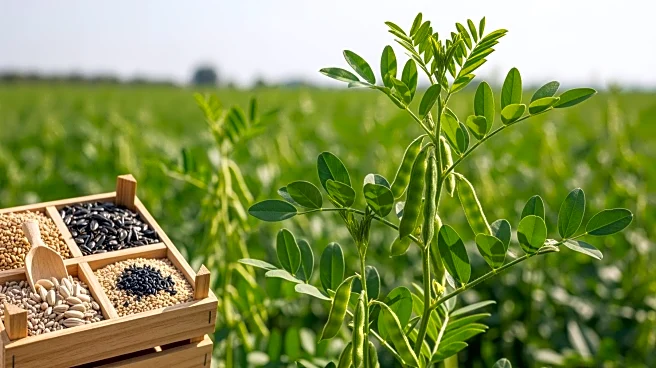
Bihar's Agriculture Minister, Ram Kripal Yadav, has called on the central government to provide dedicated support for pulse crops, including a tailored package and the establishment of a national seed hub. Speaking at a national pulse conference in Madhya
Pradesh, Yadav emphasized the need for policies that consider Bihar's unique geography and climate. He advocated for the recognition of specific pulse crops such as arhar, chana, masoor, urad, and moong as state-specific. Yadav also proposed a cluster-based farming model with comprehensive support for irrigation, seeds, and machinery, and requested up to 90% central subsidy for irrigation systems. Additionally, he sought improved MSP procurement, value addition incentives, and research grants to enhance Bihar's pulse self-reliance within five years.
Why It's Important?
The call for a dedicated pulse support package and seed hub is significant as it aims to boost Bihar's agricultural productivity and self-reliance in pulse production. By recognizing state-specific pulse crops and providing tailored support, the initiative could enhance the livelihoods of farmers in Bihar, a state heavily reliant on agriculture. The proposed measures, including subsidies and improved procurement processes, could lead to increased production efficiency and economic benefits for the region. This move also aligns with broader national goals of achieving self-reliance in agriculture, potentially reducing dependency on imports and stabilizing domestic markets.
What's Next?
If the central government approves the proposed measures, Bihar could see the establishment of a national seed hub and the implementation of a cluster-based farming model. This would involve significant investment in infrastructure and resources, including irrigation systems and specialized machinery. The success of these initiatives would depend on effective collaboration between state and central governments, as well as the active participation of local farmers. The establishment of permanent procurement centers and the promotion of value addition through processing units could further enhance the economic viability of pulse farming in Bihar.