




What's Happening?
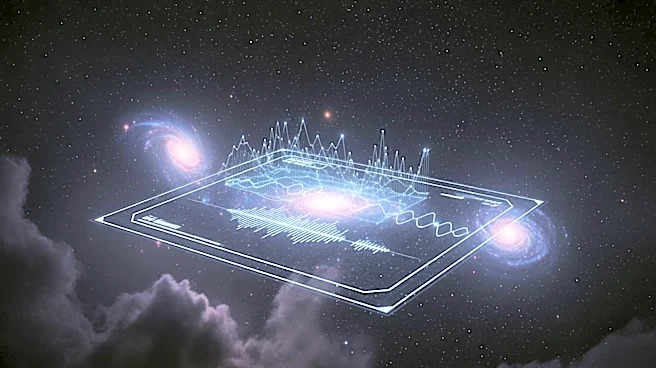
The European Space Agency (ESA), in collaboration with NASA, has utilized an AI-assisted method named AnomalyMatch to analyze nearly 100 million image cutouts from the Hubble Legacy Archive. This effort, led by ESA researchers David O'Ryan and Pablo Gómez,
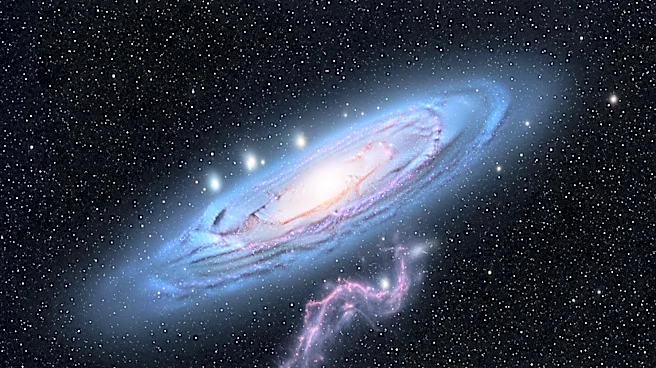
resulted in the identification of approximately 1,300 anomalous images, revealing nearly 1,400 unique objects. Notably, over 800 of these objects had not been previously documented in scientific literature. The AI tool completed its analysis in about two and a half days, producing a ranked list of unusual images. The findings include gravitational lenses, galaxy mergers, ring galaxies, jellyfish galaxies, and massive star-forming clumps, among others. These discoveries were made possible by the AI's ability to rank images based on their unusual characteristics, which were then manually inspected by the researchers.
Why It's Important?
This development is significant as it highlights the potential of AI in advancing astronomical research. By identifying previously undocumented cosmic phenomena, the AI tool enhances our understanding of the universe and its complexities. The discovery of new objects and anomalies can lead to further scientific inquiry and potentially groundbreaking insights into the formation and evolution of galaxies. This collaboration between ESA and NASA underscores the importance of international cooperation in space exploration and the role of technology in pushing the boundaries of scientific knowledge. The findings could influence future research priorities and funding allocations in the field of astronomy.
What's Next?
Following the identification of these anomalies, further analysis and verification will likely be conducted to understand the nature and significance of these objects. Researchers may focus on detailed studies of specific anomalies to uncover new insights into cosmic phenomena. The findings could also prompt the development of new classification schemes for celestial objects. Additionally, the success of the AnomalyMatch tool may encourage the adoption of similar AI technologies in other areas of space research, potentially leading to more efficient and comprehensive data analysis processes.
Beyond the Headlines
The use of AI in this context raises questions about the future role of technology in scientific discovery. As AI tools become more sophisticated, they may increasingly complement human expertise, allowing researchers to focus on interpreting complex data rather than processing it. This shift could lead to a reevaluation of traditional research methodologies and the skills required for future astronomers. Moreover, the ethical implications of relying on AI for scientific discovery, such as data privacy and algorithmic bias, may become more prominent as these technologies are integrated into research practices.