
What's Happening?
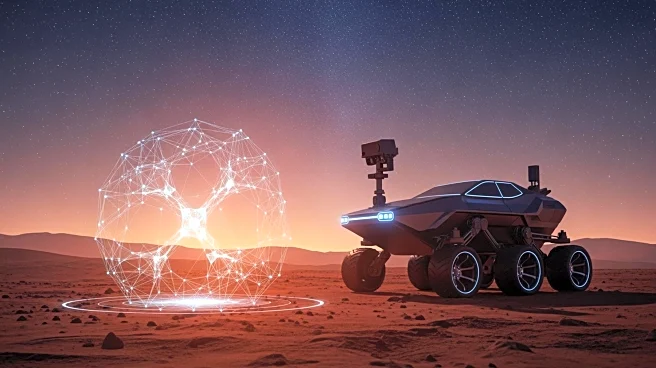
NASA has launched a new initiative called Foundational Artificial Intelligence for the Moon and Mars (FAIMM), aimed at enhancing scientific and exploration applications through large AI models. This program,
part of NASA's Research Opportunities in Space and Earth Sciences (ROSES) 2025, seeks to involve researchers in developing AI applications for lunar and Martian exploration. However, the initiative has notably excluded any mention of astrobiology, which has traditionally been a central aspect of Mars exploration. The omission has raised questions, given that the search for life has been a primary motivation for Mars missions over the past six decades. The FAIMM program will focus on tasks such as crater detection and landing site assessment, utilizing large datasets to improve AI model accuracy and application.
Why It's Important?
The exclusion of astrobiology from NASA's new AI initiative is significant as it marks a shift in focus from the traditional goals of Mars exploration. Astrobiology has been a key driver in understanding the potential for life on Mars, influencing both scientific research and public interest. By not prioritizing astrobiology, NASA may be signaling a change in its exploration strategy, potentially impacting future funding and research directions. This shift could affect scientists and researchers who have dedicated their work to the search for extraterrestrial life, as well as the broader scientific community that relies on astrobiology findings to inform other areas of study.
What's Next?
The FAIMM program is set to proceed with its current focus, with proposals due by April 28, 2026. As the program develops, it will be important to monitor how NASA balances its new AI-driven objectives with the traditional goals of Mars exploration. Stakeholders in the scientific community may advocate for the inclusion of astrobiology in future iterations of the program, potentially influencing NASA's strategic priorities. Additionally, the open-source nature of the AI models and datasets could lead to independent research efforts that continue to explore astrobiological questions, even if they are not directly supported by NASA's current initiative.
![Daily Slop: 12 Feb 26 – New Commanders OC David Blough: “How do we get Terry [McLaurin] 10 targets a game?“](https://glance-mob.glance-cdn.com/public/cardpress/binge-magazine-card-generation/spaces/US/en/sb-nation/images/ppid_2cf3d240-image-177091266842313096.webp)