







What's Happening?
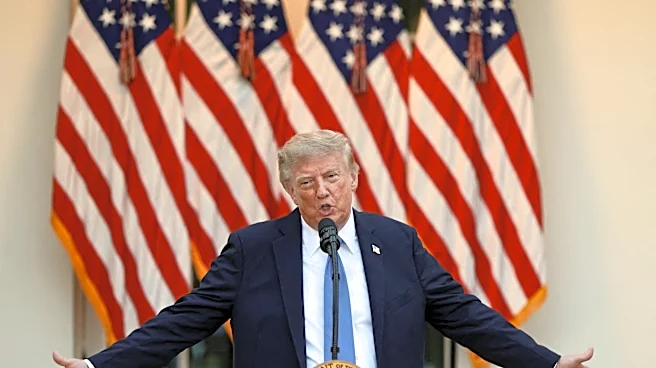
President Trump has asserted that his investment activities, including in stocks and other assets, have generated hundreds of billions of dollars for the United States, not for his personal gain. He made these claims on his social media platform, Truth
Social, dismissing criticisms from Democrats regarding his personal trading activities. President Trump shared an AI-generated image depicting him at the Resolute Desk surrounded by trading screens, one of which showed a 'bought: Intel $20' transaction and another indicating the stock's current price at $95. His administration reportedly acquired approximately 10% of Intel Corporation's shares in August 2025 at $20.47 per share, a total investment of $8.9 billion, which was below market price. Intel's stock has since seen significant increases, rising 143.27% this year and 291.34% over the past year.
Why It's Important?
President Trump's statements and actions regarding his investments and public comments on individual stocks have repeatedly drawn ethical scrutiny. The claim of generating billions for the U.S. through his trading, while simultaneously facing criticism for potential conflicts of interest, highlights ongoing debates about the financial conduct of government officials. The significant appreciation of Intel's stock after his administration's investment could raise questions about market influence or privileged information, regardless of intent. This situation underscores the broader discussion about transparency and accountability for high-ranking government officials, particularly concerning their personal financial dealings and public pronouncements that could affect market dynamics. The push by Democrats for legislation to prohibit government officials from trading stocks, digital assets, and futures contracts reflects a desire to mitigate these perceived conflicts of interest.
What's Next?
The ethical concerns surrounding President Trump's personal trading and public statements on stocks are likely to persist, especially as Democrats continue to advocate for stricter regulations on government officials' financial activities. Congressman Eugene Vindman has already introduced the 'Sell Your Stocks or Step Down Act,' aimed at prohibiting the President, Vice President, and members of Congress from trading stocks, digital assets, and futures contracts. This legislative push suggests that the debate over financial ethics in government will remain a prominent issue. President Trump's continued use of social media to comment on market performance and his own investments will likely keep this topic in the public discourse, potentially influencing voter perceptions and future policy discussions on government transparency.
Beyond the Headlines
The controversy surrounding President Trump's stock trading and his defense of these actions touches upon fundamental questions of public trust and the integrity of government. The use of an AI-generated image to illustrate his investment activities adds a modern dimension to political communication, blurring the lines between reality and digital representation. This situation also highlights the challenges of regulating financial conduct for individuals in positions of immense power, where even perceived conflicts of interest can erode public confidence. The broader implication is a continued re-evaluation of ethical guidelines and disclosure requirements for elected officials, particularly in an era where personal wealth and public office frequently intersect, and social media provides an immediate platform for market-moving statements.