




What's Happening?
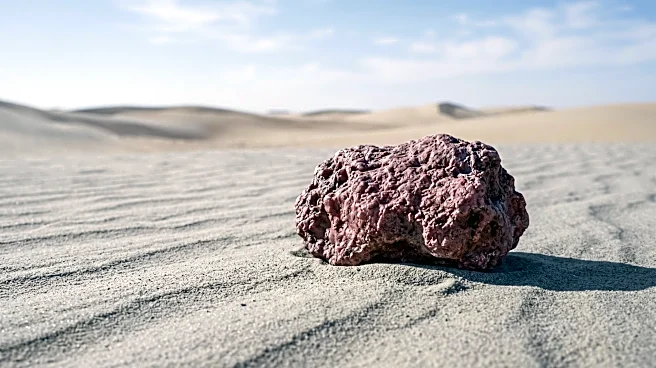
A NASA-funded study has confirmed that the Teghaza 001 meteorite, an 800-gram rose-colored rock found in the Sahara Desert in 2022, originated from Mars over 4.1 billion years ago. This rare meteorite is considered a pristine fragment of the Red Planet’s
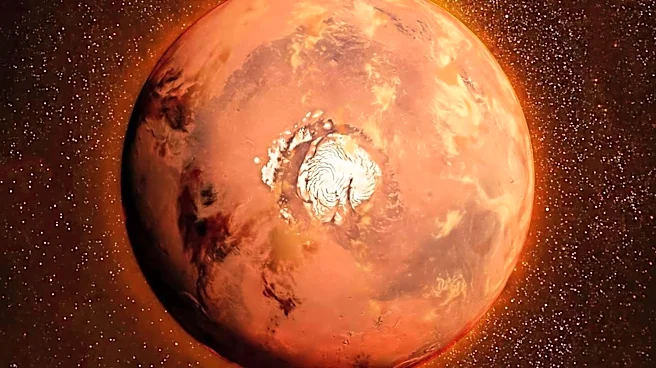
primordial crust and is one of approximately 435 confirmed Martian meteorites on Earth. Researchers describe it as a geological 'Rosetta Stone' for early Mars. The meteorite crystallized from cooling magma in the Martian crust during the planet’s Noachian era. Spectroscopic and mineralogical data from the meteorite align with observations from NASA’s Mars Reconnaissance Orbiter (MRO), pointing to 13 potential source areas, primarily in the heavily cratered southern highlands of Mars. It was ejected into interplanetary space following a massive asteroid or comet impact before eventually intersecting Earth’s orbit. Oxygen isotope analysis at the University of New Mexico confirmed its Martian origin.
Why It's Important?
The Teghaza 001 meteorite offers unprecedented insights into the early history of Mars, particularly regarding the presence of water and atmospheric evolution. Its distinctive pink hue and diverse volcanic minerals provide clues about the formation and evolution of Mars’ early crust. The meteorite contains microscopic zircon crystals that preserve isotopic records, which are crucial for determining the rock’s age and geological history. Scientists utilized advanced in-situ rubidium-strontium dating to analyze tiny mineral grains without damaging the sample. Crucially, geological and isotopic signatures within the meteorite indicate that liquid water circulated through Mars’ crust around 4.1 billion years ago, suggesting early hydrothermal activity. This discovery could significantly advance our understanding of Mars' potential for past life and its environmental changes.
What's Next?
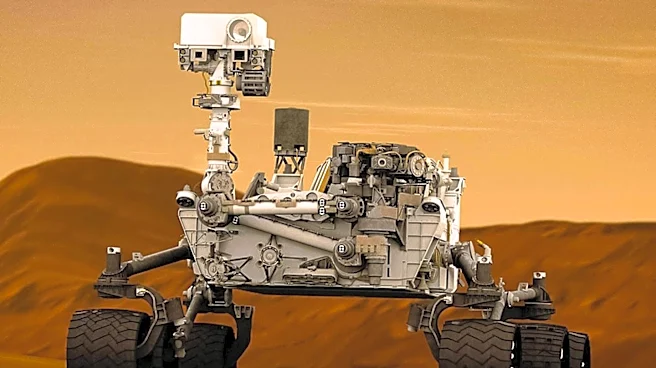
Further analysis of the Teghaza 001 meteorite is expected to continue providing valuable data on Mars' ancient past. Researchers will likely focus on extracting more detailed information from its geochemical evidence to better understand the interactions between rocks, water, and the Martian atmosphere. This ongoing research could refine existing models of Martian geological and atmospheric evolution. The findings from this 'Rosetta Stone' are anticipated to guide future NASA missions to Mars, influencing the selection of landing sites and the types of scientific instruments deployed, as scientists seek to confirm and expand upon the insights gained from this unique extraterrestrial sample.
Beyond the Headlines
The discovery of the Teghaza 001 meteorite has profound implications beyond just Martian geology, touching upon the broader scientific quest for understanding planetary formation and the conditions necessary for life. The concept of a 'Rosetta Stone' for Mars highlights the meteorite's role in deciphering complex planetary processes, much like the ancient artifact helped unlock Egyptian hieroglyphs. This find underscores the value of meteorite hunting and analysis as a cost-effective method for studying other planets, complementing expensive space missions. It also raises ethical considerations regarding the preservation and study of such rare extraterrestrial materials, ensuring that their scientific potential is maximized for the benefit of humanity's understanding of the cosmos.