



What's Happening?
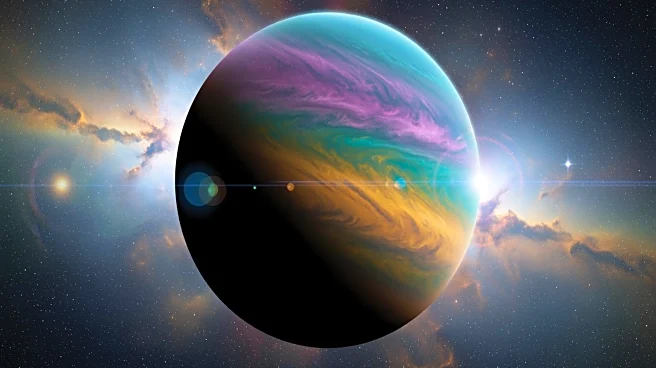
The James Webb Space Telescope (JWST) has discovered an exoplanet, PSR J2322-2650b, with a unique helium-and-carbon-dominated atmosphere. This exoplanet orbits a pulsar and is distorted into a lemon shape due to gravitational forces. The planet's atmosphere contains
molecular carbon and soot clouds, and theoretical models suggest that intense internal pressure could condense its carbon into diamonds. The discovery challenges existing planetary formation theories, as the exoplanet's characteristics do not align with known processes. The JWST's observations were facilitated by the pulsar's gamma-ray emissions, allowing detailed spectroscopic analysis without interference from the star's luminosity.
Why It's Important?
This discovery provides new insights into planetary formation and the diversity of exoplanetary systems. The unusual composition of PSR J2322-2650b's atmosphere challenges current understanding and suggests that there may be more exotic planets in the universe than previously thought. The findings could lead to a reevaluation of planetary formation models and inspire further research into the conditions that allow such unique atmospheres to develop. Additionally, the ability to study an exoplanet in detail without interference from its host star opens new possibilities for exoplanetary research.
Beyond the Headlines
The discovery of PSR J2322-2650b raises questions about the processes that lead to such exotic planetary compositions. It also highlights the potential for discovering other unusual exoplanets with the JWST, which could further expand our understanding of the universe. The study of this exoplanet may also provide insights into the potential for life in extreme environments, as understanding the atmospheric conditions could inform the search for habitable worlds.