



What's Happening?
Theoretical physicist Subir Sarkar from the University of Oxford is challenging the widely accepted theory that the universe is accelerating in its expansion due to dark energy. Sarkar, along with researchers Animesh Sah and Mohamed Rameez, has re-evaluated
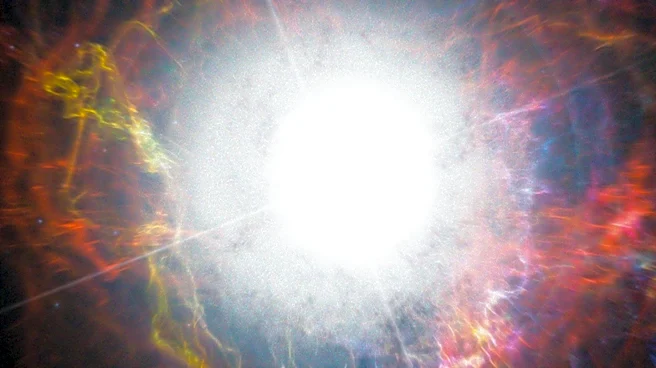
data from Type Ia supernovae, which have traditionally been used to support the existence of dark energy. By applying a correction for the age of the progenitor stars, the team found that supernovae from younger progenitors appear fainter than those from older ones. This faintness, they argue, creates an illusion of acceleration. Their findings suggest that the universe's expansion may not be isotropic, as previously thought, but rather anisotropic, meaning it does not accelerate uniformly in all directions.
Why It's Important?
This new perspective on cosmic expansion could have significant implications for our understanding of the universe. If the universe is not accelerating as previously believed, it challenges the foundational assumptions of the Lambda-Cold Dark Matter (ΛCDM) model, which is central to modern cosmology. The potential anisotropy in cosmic expansion could mean that dark energy, a mysterious force thought to drive acceleration, may not exist as theorized. This revelation could lead to a paradigm shift in cosmology, prompting scientists to reconsider the nature of the universe and the forces that govern it. The findings also highlight the importance of re-evaluating existing data with new methodologies to uncover hidden insights.
What's Next?
The scientific community is likely to scrutinize these findings, as they challenge long-standing cosmological models. Further research and observations will be necessary to confirm or refute Sarkar's conclusions. This could involve more detailed studies of supernovae and other cosmic phenomena to better understand the universe's expansion dynamics. If validated, these findings could lead to new theoretical models that better explain the universe's behavior. Additionally, the debate may inspire new technological advancements in observational astronomy to gather more precise data.
Beyond the Headlines
The implications of this research extend beyond theoretical physics, touching on philosophical and existential questions about the universe's nature. If dark energy does not exist as previously thought, it raises questions about the universe's ultimate fate and our place within it. The potential anisotropy in cosmic expansion could also influence how we understand the universe's structure and evolution, potentially affecting other fields such as astrophysics and cosmology. This research underscores the dynamic nature of scientific inquiry, where established theories are continually tested and refined.