
What's Happening?
Researchers in Klaserie Private Nature Reserve, part of the Greater Kruger Conservation Area, have been working for the past 25 years to improve the conservation status of the southern ground hornbill.
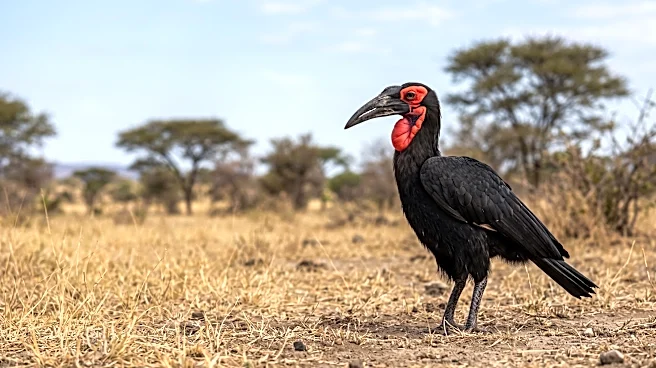
This species, one of Kruger’s 'Big Six Birds,' is distinctive with its glossy black plumage, large size, bright red throat pouch, and powerful bill. Despite their ability to fly and roost in trees, they primarily spend their time on the ground, moving in territories that can span several square kilometers. These groups are typically composed of predominantly male birds led by a dominant female. The population of these charismatic birds has significantly declined due to human encroachment, persecution (as some consider them bad omens), and a scarcity of suitable nesting sites. They are particular about nesting in tree cavities, and even artificial nests often prove difficult to maintain. Their biology also presents challenges, as they can live for 50 to 60 years but only reach breeding age at seven or eight, and may breed intermittently. They also exhibit a behavior where only one chick is raised, with the other often perishing.
Why It's Important?
The conservation of the southern ground hornbill is crucial for maintaining biodiversity within the Greater Kruger Conservation Area. As an emblematic species, its decline signals broader ecological issues that could impact the region's ecosystem. The challenges faced by these birds, such as habitat loss and human-wildlife conflict, are indicative of pressures on other species as well. The long-term research and dedicated efforts in Klaserie demonstrate a commitment to preserving endangered wildlife, which can serve as a model for other conservation initiatives. The success in nearly doubling the population in 25 years highlights the effectiveness of sustained conservation strategies and the importance of understanding species-specific biological and behavioral patterns. Protecting such species contributes to the overall health and resilience of the natural environment, which in turn supports eco-tourism and local economies dependent on wildlife.
What's Next?
The ongoing efforts in Klaserie Private Nature Reserve will likely continue to focus on monitoring the southern ground hornbill population, addressing habitat challenges, and mitigating human-wildlife conflicts. Researchers will persist in their attempts to understand the species' unique breeding patterns and social structures to further enhance conservation strategies. The experience gained from this long-term project could inform conservation practices for other vulnerable species within the Greater Kruger Conservation Area and beyond. Continued public awareness campaigns may also be necessary to educate local communities about the importance of these birds and to dispel superstitions that lead to their persecution. The success of this program suggests that sustained, dedicated efforts, combined with scientific understanding, are key to the future of the southern ground hornbill.
Beyond the Headlines
The conservation story of the southern ground hornbill extends beyond mere population numbers, touching upon the intricate balance between human development and ecological preservation. The challenges of human encroachment and persecution underscore the need for integrated conservation approaches that involve local communities and address socio-cultural factors. The species' complex biology, including its late breeding age and selective chick-rearing, highlights the delicate nature of wildlife populations and the significant time investment required for recovery. This case also brings to light the broader ethical considerations of human impact on natural habitats and the responsibility to protect biodiversity. The dedication of researchers over decades reflects a long-term commitment to environmental stewardship, emphasizing that effective conservation is a continuous process requiring patience, scientific rigor, and community engagement.