







What's Happening?
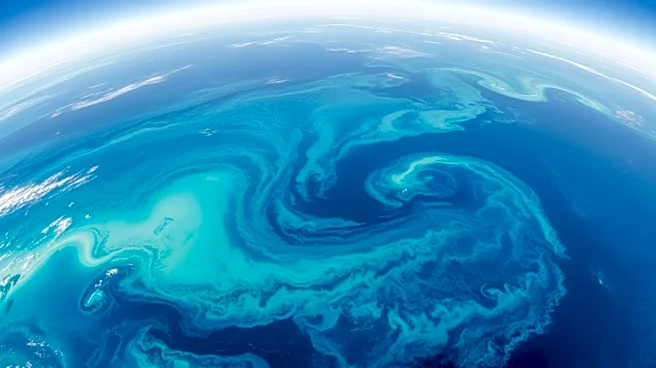
NASA satellites have detected a significant blue-green bloom along the coastlines of New Jersey, Delaware, Maryland, and Virginia. This phenomenon, first noticed in mid-April, has expanded into large swirling patterns visible from space. The bloom is characterized
by a mix of blue, green, and brown waters, extending for hundreds of kilometers along the eastern seaboard. According to NASA, the bloom is driven by river outflows, spring storms, and a dense population of phytoplankton, microscopic marine organisms. These blooms are crucial for understanding ocean health as they play a vital role in oxygen production and serve as a foundational food source for marine ecosystems. Satellite instruments like MODIS on the Aqua satellite and the new PACE mission enable scientists to track these events with unprecedented detail, analyzing ocean color to determine organism types and densities.
Why It's Important?
The detection and monitoring of such blooms are essential for assessing ocean health and understanding the ecological roles of phytoplankton. These organisms are responsible for producing a significant portion of Earth's oxygen and form the base of the marine food web. The blooms can provide insights into ocean chemistry, particularly when dominated by coccolithophores, which have calcium carbonate plates. While these blooms are natural and usually temporary, their size and composition are closely monitored to detect potentially toxic events. The current bloom off the U.S. East Coast shows no signs of toxicity, but continuous monitoring is necessary to ensure the health of marine ecosystems and to prevent any adverse effects on local fisheries and tourism.
What's Next?
Ongoing monitoring by NASA and other scientific organizations will continue to track the bloom's development and its impact on marine ecosystems. Researchers will use satellite data to analyze the bloom's composition and density, providing valuable information for future studies on ocean health and climate change. The data collected will also help in predicting similar events and their potential effects on marine life and coastal communities. Collaboration between governmental agencies, research institutions, and local stakeholders will be crucial in managing and mitigating any negative impacts of such blooms.