



What's Happening?
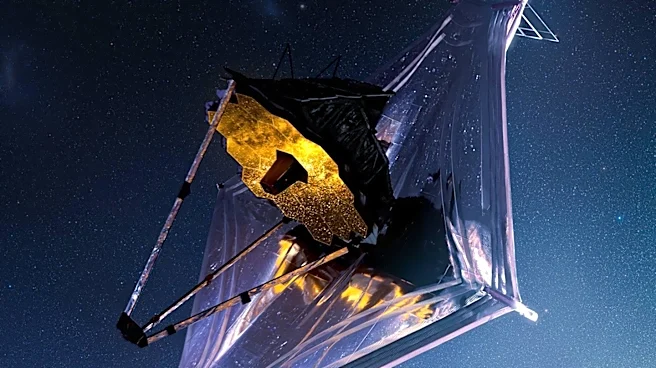
The James Webb Space Telescope (JWST) has identified spectral signatures of magnesium-rich phyllosilicates on two of Neptune's small inner moons, Larissa and Galatea, and within its rings. These minerals, which form when rock is altered by liquid water
over extended periods, indicate that the material originated from much larger primordial satellites. These larger bodies would have possessed sufficient internal heat from radioactive decay and accretion to melt water ice, allowing liquid water to circulate through their rocky interiors and cause the observed alteration. The current moons, being too small to generate such heat, suggest that they are remnants, or 'rubble,' from a more ancient and larger satellite system around Neptune. This discovery provides compelling evidence for a catastrophic event in Neptune's past, likely involving the capture of the large moon Triton.
Why It's Important?
This finding is significant for understanding the formation and evolution of planetary systems, particularly gas giants and their moons. The presence of water-altered clay minerals on Neptune's inner moons and rings supports the long-standing theory that Neptune's original satellite system was disrupted by the capture of Triton. Triton, with its retrograde orbit and Kuiper Belt origins, is believed to have destabilized the pre-existing moons, leading to collisions that broke them apart. The detection of these specific minerals acts as a 'geological sample,' providing direct chemical evidence that complements orbital dynamics models. It helps scientists reconstruct the violent history of Neptune's system, offering insights into how such systems can be dramatically reshaped by gravitational interactions and large-scale impacts. This also has implications for understanding the prevalence of water and aqueous alteration processes in the outer Solar System.
What's Next?
Future research will focus on refining dynamical simulations to better understand the precise sequence of events that led to the destruction of Neptune's primordial moons and the formation of the current inner system. Scientists will also seek to obtain more laboratory spectra under conditions mimicking the outer Solar System to further characterize the detected minerals. Observations of other small Neptunian moons are planned to determine if similar mineralogical signatures are present, which could provide a more complete picture of the debris field. Distinguishing between the favored primordial-moon explanation and alternative scenarios, such as the tidal shredding of a differentiated Kuiper Belt object, will require more detailed chemical and orbital analyses. The identity of a broad three-micrometre absorber also needs further investigation, as it could reveal whether the material is primitive hydrated rock or from deeper, hotter layers.
Beyond the Headlines
The discovery extends beyond merely confirming a past event; it highlights the power of advanced astronomical instruments like the JWST to uncover the deep history of our solar system through subtle chemical signatures. The fact that these tiny, cold moons carry evidence of internal melting and aqueous alteration from much larger parent bodies underscores the dynamic and often violent processes that shape celestial objects. This research also touches upon the broader theme of water's role in the universe, even in extreme environments far from the sun. The 'clay as a clue' approach demonstrates how mineralogical fingerprints can serve as time capsules, preserving information about conditions and events that occurred billions of years ago, thereby pushing the boundaries of our understanding of planetary geology and astrobiology.