






What's Happening?
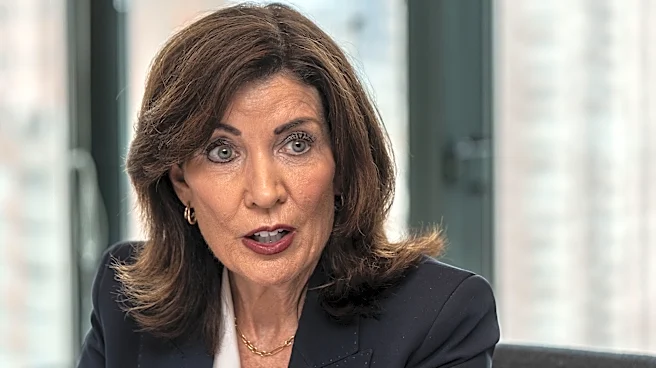
Governor Kathy Hochul has initiated a multi-million-dollar advertising campaign aimed at bolstering her re-election bid while simultaneously connecting her Republican opponent, Bruce Blakeman, to President Trump. One 30-second ad features Hochul in a pizzeria,
highlighting her record on middle-class tax cuts, free school meals, and efforts against utility companies. A second ad, however, focuses entirely on portraying Blakeman as aligned with President Trump and his policies on groceries, utilities, and healthcare, asserting that Blakeman would prioritize President Trump over New Yorkers. This ad blitz follows a Siena University poll indicating a tightening gubernatorial race, with Hochul leading Blakeman 49% to 39% among likely voters. Blakeman's campaign has criticized these ads as deceptive, arguing that Hochul's claims about tax cuts and utility accountability are misleading given alleged tax hikes and rate increases during her tenure.
Why It's Important?
This aggressive ad campaign by Governor Hochul is a critical move in the New York gubernatorial race, reflecting the high stakes and the tightening poll numbers. By linking Bruce Blakeman to President Trump, Hochul aims to leverage the Democratic-leaning state's sentiment towards the former president, potentially mobilizing her base and swaying undecided voters. This strategy is particularly significant given President Trump's continued influence within the Republican party and the polarized political environment. The financial disparity between the two campaigns, with Hochul holding a substantial war chest, allows for such extensive advertising, which can significantly shape public perception. The effectiveness of this tactic will be a key indicator of how much President Trump's endorsement or association impacts local and state elections, even after his presidency. Conversely, Blakeman's counter-narrative, accusing Hochul of deception and highlighting her own policy criticisms, underscores the intense battle for voter trust and the importance of economic issues like taxes and utility costs in the election.
What's Next?
The multi-million-dollar ad blitz is expected to intensify the gubernatorial race in New York, leading to increased media scrutiny and likely further responses from both campaigns. Blakeman's campaign, despite a financial disadvantage, is supported by Super PACs, including one bankrolled by James Dolan, which has launched its own ad criticizing Hochul's policies. This suggests an escalating advertising war, with both sides attempting to define the narrative and influence voter perception. The focus on President Trump's policies in Hochul's ads indicates that the national political climate will continue to play a significant role in state-level elections. Future polls will reveal the impact of these advertising strategies on voter sentiment. The outcome of this election will not only determine New York's leadership but also serve as a barometer for the political landscape, particularly regarding the influence of national figures on state races and the efficacy of negative campaigning tactics.
Beyond the Headlines
The New York gubernatorial race, characterized by Governor Hochul's strategy of linking her opponent to President Trump, highlights a deeper trend in modern U.S. politics: the nationalization of state elections. In an increasingly polarized environment, candidates often seek to associate their opponents with unpopular national figures or policies, rather than solely focusing on local issues. This approach can simplify complex political choices for voters but also risks overshadowing nuanced discussions about state-specific challenges and solutions. The debate over Hochul's record on taxes and utility rates, contrasted with Blakeman's claims of fiscal responsibility in Nassau County, points to the ongoing struggle for economic credibility. This election also underscores the power of campaign finance and Super PACs in shaping public discourse, where significant financial resources can dictate the volume and reach of political messaging, potentially influencing the democratic process beyond the merits of individual candidates or policies.