




What's Happening?
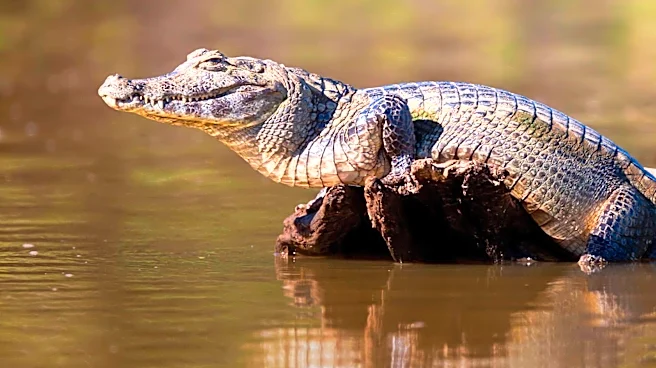
Research conducted on smooth-fronted caimans in South American rainforests has revealed that mercury pollution significantly weakens their stress hormone response. Caimans with higher levels of mercury in their blood exhibited a diminished ability to
produce stress hormones, which are crucial for their survival in the wild. This study, led by Jérémy Lemaire of the University of Vienna, involved analyzing 20 adult and nearly adult caimans in French Guiana. The findings suggest that mercury, often originating from gold mining activities and fossil fuel combustion, acts as an endocrine-disrupting chemical, interfering with the caimans' natural defense mechanisms. The levels of mercury found in the caimans were comparable to those in other crocodilians globally, indicating a widespread issue.
Why It's Important?
The weakening of the stress response in caimans due to mercury pollution has critical implications for their survival and the broader ecosystem. A robust stress response is essential for wild animals to cope with threats such as predators, extreme weather, and human disturbances. If caimans cannot effectively respond to stress, their ability to escape danger, find food, and reproduce successfully is compromised, potentially leading to increased mortality rates and population declines. Given that over a third of the 26 living crocodilian species are threatened with extinction, this mercury-induced vulnerability adds another layer of risk. Caimans, being long-lived and accumulating mercury through their diet, serve as important bioindicators of environmental pollution, highlighting the pervasive impact of human activities on remote ecosystems.
What's Next?
Further research is needed to determine the long-term effects of a weakened stress response on caiman populations, including impacts on their mortality rates and reproductive success. Scientists will also investigate whether the mechanism of mercury interfering with glucocorticoid receptors, as suggested by computer simulations and studies in rats, holds true in caiman cells. The findings necessitate urgent attention from conservationists and policymakers, particularly in regions with significant gold mining activities. Strategies to mitigate mercury pollution, such as stricter regulations on mining practices and efforts to reduce fossil fuel emissions, will be crucial. Public awareness campaigns about the dangers of mercury pollution and its impact on wildlife may also be implemented to foster support for conservation efforts.
Beyond the Headlines
This study underscores the insidious and far-reaching effects of environmental pollutants on wildlife, even at levels previously considered non-alarming. Mercury, a neurotoxin, is shown here to disrupt fundamental physiological processes, highlighting the complex ways human-generated pollution can undermine the resilience of species. The fact that caimans, apex predators in their ecosystems, are affected suggests a cascading impact throughout the food web. This issue raises ethical concerns about the responsibility of industries and governments to protect biodiversity from the consequences of economic activities. It also points to the need for a holistic approach to environmental health, recognizing that the well-being of wildlife is intrinsically linked to the health of human populations and the planet as a whole. The study serves as a stark reminder that environmental contamination can have subtle yet profound consequences that may take years to fully manifest.