





What's Happening?
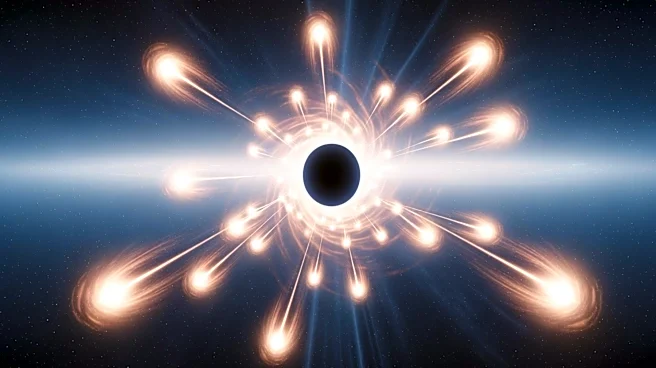
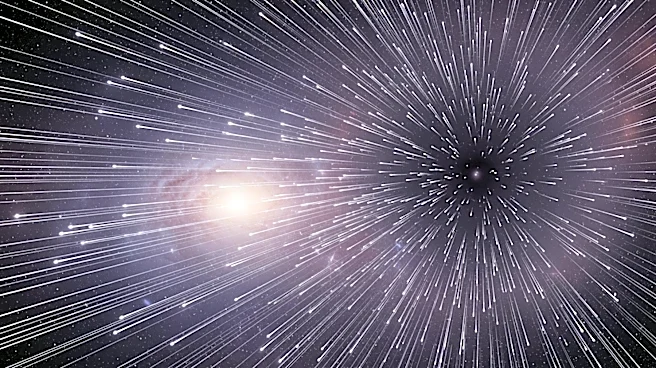
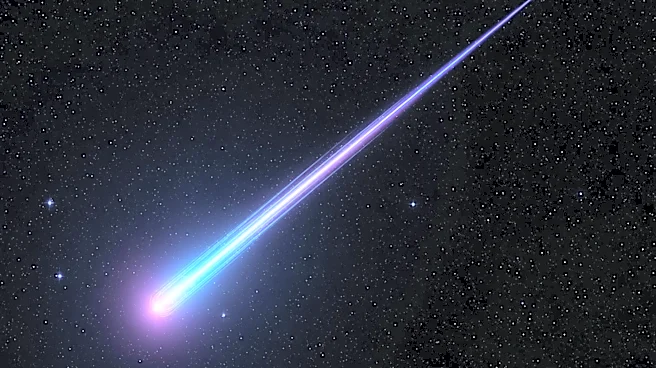
New research led by Penn State scientists suggests that some of the highest-energy cosmic rays may consist of atomic nuclei heavier than iron. These ultrahigh-energy cosmic rays, which strike Earth with energies far beyond those reachable by human-made
particle accelerators, have long puzzled scientists. The study, published in Physical Review Letters, indicates that ultraheavy nuclei can lose energy more slowly than protons or lighter nuclei as they travel through intergalactic space, allowing them to reach Earth at extreme energies. This finding could help narrow down the cosmic sources capable of accelerating these particles, such as massive star deaths or binary neutron-star mergers.
Why It's Important?
Understanding the composition and origins of ultrahigh-energy cosmic rays is crucial for astrophysics, as these particles are among the most energetic phenomena in the universe. Identifying their sources could provide insights into extreme cosmic events, such as neutron star collisions and black hole formations, which are also associated with gravitational waves and gamma-ray bursts. This research could also impact our understanding of the universe's structure and the processes that govern high-energy astrophysical phenomena. The study's findings may guide future observations and experiments aimed at detecting and analyzing these cosmic rays.
What's Next?
Next-generation observatories, such as the proposed AugerPrime in Argentina and the Global Cosmic Ray Observatory, could test the signatures of ultraheavy nuclei in cosmic rays. Further theoretical studies of cosmic explosions involving black holes and strongly magnetized neutron stars could help clarify the origin of these particles. Researchers will continue to refine their models and simulations to better understand the mechanisms behind the acceleration and propagation of ultrahigh-energy cosmic rays. Collaboration between international research institutions will be essential to advance this field and uncover the mysteries of these cosmic messengers.